
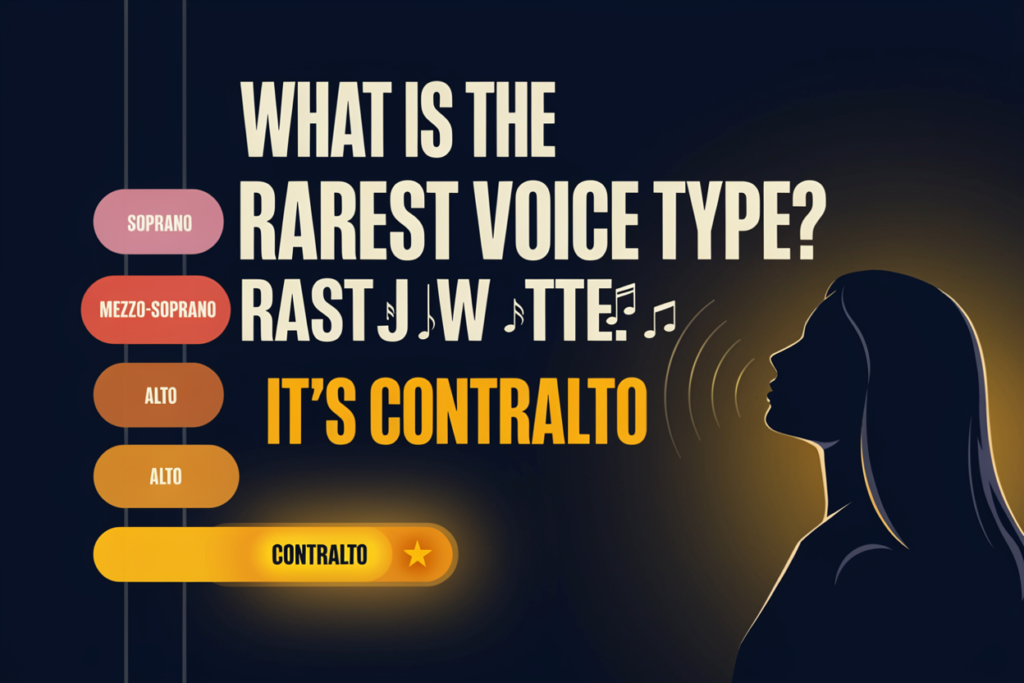
The rarest voice type is usually discussed in two ways: contralto is often considered the rarest female voice type, while true bass is often considered one of the rarest male voice types. Some trained performance categories, such as countertenor or dramatic operatic voices, can also be rare, but contralto and true bass are the clearest beginner-friendly answers.
Exact rarity is difficult to measure because there is no single global database of every singer’s natural voice type. Choir labels, classical categories, pop singing styles, training level, age, and vocal development all affect how people are classified. If you want to check your own voice, start with a vocal range calculator and compare your results with a voice type range chart, but do not classify yourself from one extreme note alone.
What Is the Rarest Voice Type?
The rarest commonly discussed voice types are contralto for female singers and true bass for male singers. Contralto is rare because naturally low female voices with a low tessitura and darker vocal weight are uncommon. True bass is rare because many low male singers are actually baritones with some low notes, not full basses.
| Voice Type | Why It Is Considered Rare |
|---|---|
| Contralto | Lowest female solo voice type; naturally low tessitura is uncommon |
| True bass | Lowest common male voice type; deep comfortable low range is less common |
| Countertenor | Rare trained performance category using high male register coordination |
| Dramatic voices | Rare because they require size, stamina, weight, and range |
Rare does not mean better. A common voice type can be excellent, and a rare voice type still needs training, musicality, and healthy technique.
Why Voice Type Rarity Is Hard to Measure
Voice type rarity is not as simple as counting how many people can sing a high or low note. Most people are never formally classified by a voice teacher. Many singers use pop styles that do not fit neatly into classical categories. Choir directors may assign singers to parts based on balance, not true solo voice type.
For example, someone may sing alto in choir but actually be a mezzo-soprano. A male singer may reach a few low notes but still be a baritone. A singer may use falsetto to sing very high but not be a countertenor in the classical performance sense.
That is why the guide on how rare your voice type is is useful for deeper context. It explains why rarity depends on classification method, not just vocal extremes.
Rarest Female Voice Type: Contralto
Contralto is usually considered the rarest female voice type. It is the lowest female solo voice category, sitting below mezzo-soprano. A true contralto usually has a naturally low tessitura, darker tone, and comfortable lower range.
The important word is comfortable. A singer who can touch a low note once is not automatically contralto. The low range needs to feel natural, usable, and repeatable. A contralto voice also tends to have a distinct weight and color that separates it from a mezzo-soprano singing low.
For broader context, read the guide to female voice types and the more specific page on contralto vocal range. If you sing alto in choir, also check alto vs contralto because the two terms are often confused.
Rarest Male Voice Type: True Bass
For male singers, true bass is often considered one of the rarest common voice types. A true bass has a naturally deep voice, strong low notes, and a comfortable low tessitura. Many men can sing some low notes, but fewer have the depth, weight, and comfort that define a real bass voice.
This is where baritone confusion happens. Baritone is the most common middle male category, and some baritones can sing low enough to sound bass-like in certain songs. But if the voice’s natural center is higher, the singer is usually still baritone rather than bass.
The guide to male voice types explains the larger category system, while the bass vocal range page gives more detail on the lowest common male voice type.
What About Countertenor and Dramatic Voices?
Countertenor is also rare, but it is different from simply having a naturally high male voice. A countertenor is usually a trained male singer who performs in a high range using falsetto, head voice, or specialized register coordination. It is a rare performance category, especially in classical and early-music settings, but it should not be confused with every male singer who can sing high.
Dramatic voices can also be rare. A dramatic soprano, dramatic mezzo, heldentenor, or basso profundo requires more than range. These voices often need vocal size, stamina, weight, projection, and maturity. That is why dramatic categories are usually discussed more carefully in classical singing. The guide to operatic voice types can help explain those labels.
Rare Voice Type vs Rare Vocal Range
A rare vocal range is not the same as a rare voice type. Someone may be able to hit a very low note in the morning or produce a very high note in falsetto, but that does not prove a rare classification.
Voice type depends on several factors:
- Tessitura
- Tone color
- Vocal weight
- Passaggio
- Comfort
- Repeatability
- How the voice functions across songs
The article on what tessitura means is important here. Tessitura tells you where your voice works best, not just the highest or lowest note you can touch.
How to Know If Your Voice Type Is Rare
You may have a rare voice type if your range and tessitura consistently match a less common category, not just because you can sing one unusual note.
Signs to look for:
- Your low or high range feels natural, not forced
- Your comfortable tessitura matches the rare category
- Your tone and vocal weight fit the type
- You can repeat the range across songs, not only once
- Your voice remains clear without throat pressure
- A teacher or trained listener hears the same pattern over time
A singing voice test can help you explore your usable range, while a voice analyzer can help you observe pitch behavior. If you are curious about pitch and frequency, a voice frequency test can add another layer of information.
Common Mistakes About Rare Voice Types
Avoid these mistakes:
- Thinking rare means better
- Calling yourself contralto because you can sing one low note
- Calling yourself bass because your speaking voice is deep
- Assuming alto and contralto are always the same
- Treating falsetto high notes as automatic countertenor proof
- Ignoring tessitura and comfort
- Forcing your voice lower or higher to sound rare
- Treating voice type as a ranking system
A healthy voice type label should describe your voice honestly. It should not pressure you into singing outside your comfort zone.
Learn more about your singing voice by taking our online voice type test.
FAQ
What is the rarest voice type?
Contralto is often considered the rarest female voice type, while true bass is often considered one of the rarest male voice types.
What is the rarest female voice type?
Contralto is usually considered the rarest female voice type because naturally low female voices with low tessitura and darker vocal weight are uncommon.
What is the rarest male voice type?
True bass is often considered one of the rarest male voice types because deep, comfortable low male voices are less common than baritone or tenor voices.
Is contralto rare?
Yes. Contralto is considered rare compared with soprano and mezzo-soprano, especially when the singer has a naturally low tessitura rather than just a few low notes.
Is bass voice rare?
True bass voices are relatively rare. Many low male singers are actually baritones with low extension.
Is countertenor the rarest voice type?
Countertenor is rare as a trained performance category, but it is different from a natural speaking voice type or basic choir classification.
Is soprano rare?
Soprano is not usually considered the rarest female voice type. It is one of the most common female categories, especially in choir and classical contexts.
Does rare mean better?
No. Rare does not mean better. Vocal quality depends on training, health, musicality, tone, control, and expression.
How do I know if my voice type is rare?
Test your range, notice your tessitura, compare your tone and comfort with standard categories, and avoid judging from one extreme note.
Can your voice type change?
Your voice can develop with age, training, and health. However, your basic vocal structure usually does not change completely. The guide on whether voice type can change explains this in more detail.

Benjamin Parker is a voice classification and singing analysis writer at VoiceTypeTest. He focuses on vocal type identification, vocal range analysis, pitch recognition, and singing education tools for vocalists, musicians, choir singers, and beginners.