
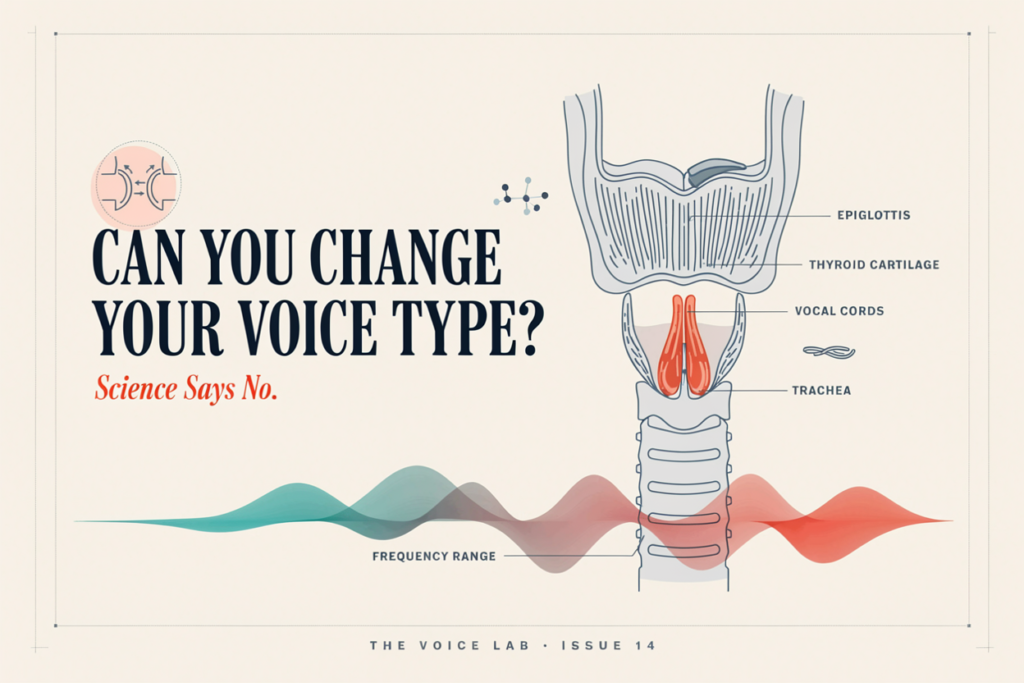
Your voice type is determined by your vocal anatomy—the size and shape of your vocal folds, the structure of your larynx, and your resonant cavities. These physical characteristics are largely permanent, so your voice type is largely permanent too. You won’t become a different voice type through training, and attempting to change your type through misguided methods can lead to strain and frustration. What you can change is your range, your technique, your voice’s power and resonance, and your ability to access different registers—all within your voice type.
The short answer: no, you cannot change your voice type. The longer answer: yes, you can develop and transform your voice so significantly that you might wonder if you’ve changed, but what’s actually happening is sophisticated development within your existing type.
Learn more about your singing voice by taking our online voice type test.
What Is Voice Type Really?
Your voice type is a classification based on your vocal anatomy and resonance characteristics. It’s not chosen; it’s revealed. It’s as permanent as your height or body type—you can develop muscle and change your appearance, but your fundamental build stays the same. Similarly, your voice type reflects your fundamental vocal structure, not a choice you make or a cage you’re trapped in.
Understanding Vocal Anatomy and Voice Type Resonance
Your voice type emerges from how your specific vocal folds vibrate and how your vocal tract (your throat, mouth, sinuses, and chest) resonate those vibrations. A soprano’s vocal folds are typically smaller and vibrate at higher frequencies; a bass’s vocal folds are larger and vibrate at lower frequencies. This isn’t something training changes. You can develop technique, stretch your range, and refine your resonance—but you can’t change the fundamental size and characteristics of your vocal anatomy.
Your tessitura—the range where your voice feels most comfortable and resonant—reflects this anatomy and is similarly stable. If your comfortable zone is F3–F4, training might let you access G3–G5 comfortably, but your core comfort zone remains around F3–F4. That’s your voice type home base.
Tessitura vs. Range: What’s the Difference?
This distinction is crucial. Tessitura is fixed; range can extend. A soprano training intensively might extend from C4–C6 to B3–B6—doubling her accessible territory. But her tessitura, the zone where she feels strongest, remains in the soprano territory. Understanding the difference between voice type and vocal range clarifies why people get confused. The range expanded; the type didn’t.
What Changes When You Train Your Voice?
While voice type itself is stable, remarkable transformation happens in other areas.
How to Extend Your Vocal Range Without Changing Type
Range extension through training is one of the most exciting developments in vocal study. A mezzo-soprano might start with A3–A5 and train to access C3–C6—nearly two octaves added to her working range. This development is real and valuable, but she’s still classified a mezzo-soprano because her tessitura and tone remain mezzo-like. The extended range is a gift of training, not a voice type shift.
Different voice types have different practical extension potential. A tenor with natural C3–C5 might realistically extend to B2–G5 with years of dedicated work. A soprano starting C4–C6 might reach C3–A6 or beyond. The ceiling depends on vocal anatomy, but significant extension is possible for every voice type.
Developing Your Voice Type’s Full Potential
Beyond range, your voice can transform profoundly through technique, training, and artistic development. The warmth, resonance, clarity, and power of your voice can all improve dramatically. A soprano’s high notes can become soaring and effortless instead of strained. A tenor’s low notes can develop richness and weight. A bass’s top notes can become flexible and usable instead of inaccessible. These developments are real transformations—but they’re developments of your voice type, not changes to it.
Your voice’s character can evolve too. A soprano might learn to sing with more classical resonance, then develop a belt for musical theatre, then refine a jazz phrasing style. The same soprano voice type expresses itself in radically different ways depending on training, experience, and artistic intention.
Can Voice Type Shift? Rare Cases Explained
While voice type is stable, extremely rare circumstances can cause subtle shifts.
How Aging Affects Your Voice Type
Your voice naturally changes with age. Sopranos sometimes develop a lower, richer tessitura as they age, moving toward mezzo-soprano territory. Tenors might shift toward baritone territory. This happens slowly, over years, and reflects gradual changes in vocal fold structure and tissue. If you were classified a soprano at twenty-five, you might authentically feel like a mezzo-soprano at fifty-five. This is a real shift, but it’s a natural, gradual process—not something you cause or control.
Voice Type Changes from Injury and Recovery
Significant injury or vocal trauma can cause voice type to shift, though this is rare. A singer who recovers from severe vocal injury might find her voice has changed during the healing process. Similarly, a singer who pushes her voice unsustainably for years might find her natural type has shifted downward (a soprano becoming a mezzo, etc.). These shifts represent genuine changes to vocal anatomy, but they’re usually undesired and result from harm, not training.
Conversely, a singer in denial about her voice type—one who sings exclusively out of her comfortable range for years—might genuinely develop a more authentic, comfortable type classification once she stops straining and starts singing where her voice naturally lives. She hasn’t changed types; she’s discovered her actual type by releasing harmful patterns.
Why Singers Think They’ve Changed Voice Type
The confusion is understandable because voice transformation can be dramatic. Here’s what usually happens:
A singer is misclassified early—maybe told she’s a soprano when she’s actually a mezzo. She trains, extends her range, develops technique. Her new abilities (especially accessing higher notes) seem to confirm the soprano classification. Years later, she realizes her tessitura and tone have always been mezzo, not soprano. She thinks she’s changed back, but actually she was misidentified all along. What changed was training and range—not type.
Alternatively, a singer deliberately sings in the wrong voice type for years (because she likes those songs, or a teacher told her to, or personal preference). Her voice adapts and becomes conditioned to that range. When she finally sings in her actual voice type range, her voice feels weak or unfamiliar—the muscles need retraining. She might conclude she “used to be” a different type, when really she’s just rediscovering her authentic type.
Accepting Your Voice Type: Strength, Not Limitation
Your voice type isn’t a limitation; it’s your identity. A bass isn’t “stuck” in the low range—he’s the proud carrier of the acoustic foundation that makes choirs and ensembles work. A soprano isn’t “limited” to high notes; she’s the bearer of range and brilliance that classical and popular music need. Understanding your voice type means accepting who you are vocally and building on those strengths rather than fighting your anatomy.
The singers who sound best and feel most fulfilled aren’t those who forced themselves into a different type—they’re those who deeply developed their own type and mastered its potential. Invest in becoming the best version of your voice type, not in trying to become something else.
FAQ
If I train my voice for years, could I become a different voice type? No. Years of training extend your range and refine your technique, but they don’t change your vocal anatomy. You’ll remain your original voice type, just a more developed and skilled version of it.
My voice has changed since I was younger—did my voice type change? Possibly, if you’re significantly older—aging can shift voice type subtly, especially from soprano toward mezzo or tenor toward baritone. But if you’re younger, your voice type probably hasn’t changed; you’ve either developed technique that accesses different parts of your range, or you were misclassified initially.
Is my voice type determined by genetics or can I shape it? Genetics determine your vocal anatomy, which determines your voice type. You can shape your technique, extend your range, and develop your voice’s qualities, but these are developments within your type, not changes to it. Voice type is hereditary; development is learned.
I was told I’m a contralto, but I want to be a soprano—can I train to be one? No. But you might be misclassified, so first verify you’re actually a contralto by checking your tessitura and tone quality with an experienced vocal coach. If you are a contralto, embrace it—contraltos are rare, powerful, and deeply valuable. Instead of wishing to be a soprano, develop your contralto voice to its full potential. You’ll sound authentic and beautiful.
How do I know if I’m a rare voice type or if I’m just not trained yet? Work with an experienced vocal coach or music teacher who can assess your tone quality and comfort zone, not just your range. Many singers believe they’re rare when they’re simply untrained in their authentic voice type. A professional assessment cuts through confusion. Your voice type doesn’t change with training—but assessment of it becomes clearer with development.

Benjamin Parker is a voice classification and singing analysis writer at VoiceTypeTest. He focuses on vocal type identification, vocal range analysis, pitch recognition, and singing education tools for vocalists, musicians, choir singers, and beginners.