
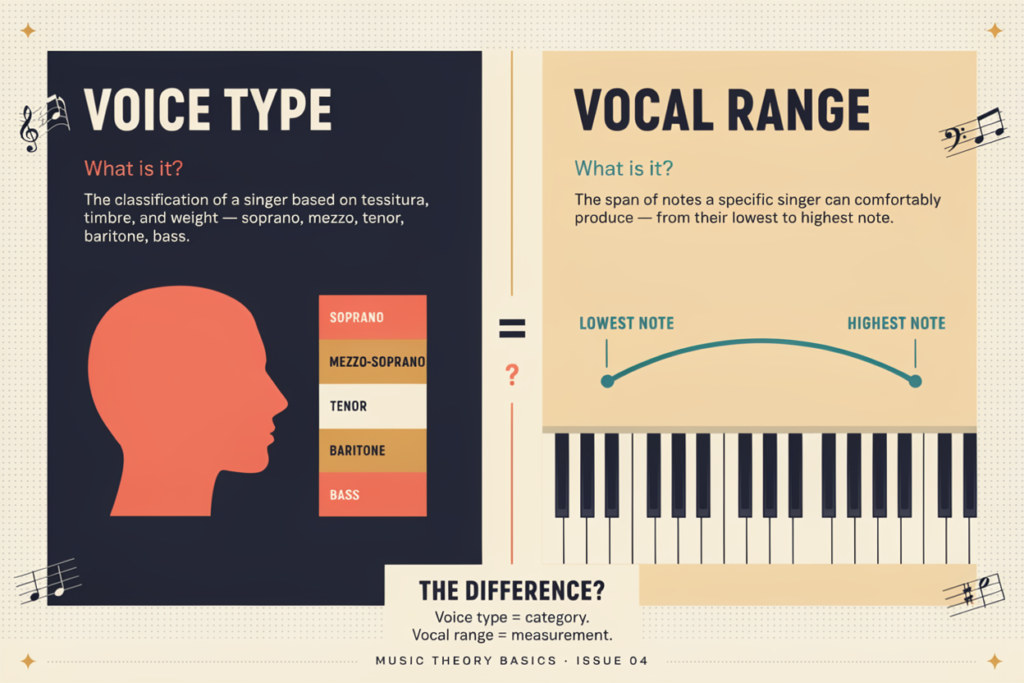
Voice type is your classification based on your natural pitch range, comfortable singing zone (tessitura), and tonal qualities. It’s relatively stable and describes where your voice naturally sits acoustically—soprano, alto, tenor, baritone, bass. Vocal range is simply the span of notes from your lowest to highest—it’s what you can physically produce. Two singers might have identical ranges but different voice types because tone quality and comfort zone differ. This distinction is fundamental, and confusing the two leads singers to misidentify themselves.
Want to know your singing voice type? Try our Voice Type Test.
Understanding Voice Type: Classification, Not Limits
Your voice type is a label that describes your vocal identity and acoustic characteristics. It tells you where your voice lives most naturally—where you feel powerful, resonant, and sustainable. A soprano isn’t someone who can sing the highest note ever; she’s someone whose voice naturally sits in the soprano range and has the characteristic warmth, brightness, or other tonal quality of a soprano. Voice type is about your vocal anatomy—the size of your vocal folds, the shape of your larynx, the resonance of your cavities—and these are largely fixed. A soprano voice type remains constant regardless of training or genre.
Voice type classification comes from classical vocal training but applies across all genres. A pop soprano is still a soprano; a jazz tenor is still a tenor. The classification remains consistent even as style, technique, and repertoire change.
Vocal Range Explained: How Far You Can Sing
Your vocal range is the measurable span from your lowest sustainable note to your highest sustainable note. A soprano might have a range of C4–C6, meaning she can produce any note between middle C and two octaves above. A tenor might have C3–C5. A bass might have E2–E4. Range is quantifiable and specific; you can measure it in note names and frequencies.
Range can extend with training. A soprano who initially can reach C4–C5 might, after years of work with a vocal coach, extend to B3–B6. Her range expanded through training, but her voice type remains soprano because her tessitura and resonance quality haven’t fundamentally shifted.
Why Singers Confuse Voice Type and Range
The confusion happens because voice type and range are tightly related. Your voice type comes with a typical range—sopranos are typically C4–C6. When a beginning singer learns her range is C4–C6, she assumes she’s a soprano, which is usually correct. But the logic isn’t “if your range is C4–C6, you’re a soprano.” The logic is “if your comfortable zone, resonance, and tone quality are soprano-like, and your range fits that classification, you’re a soprano.”
The problem arises when singers extend their range. A mezzo-soprano (typically A3–A5) might train intensively and access B2–B5—suddenly she can sing lower and higher. Does this make her a different voice type? No. Her tessitura and tone haven’t changed. She’s a mezzo-soprano with an extended range. But if she judges voice type purely by range numbers, she might conclude she’s now a contralto or a soprano. This is the source of much self-confusion.
How Voice Type and Range Work Together
Think of voice type as your home base and range as how far you can travel from it. Your home base is where you want to live—where singing feels easiest and most natural. Your range is your potential territory.
Can You Extend Your Vocal Range Without Changing Your Type?
Training extends range all the time. A tenor working with a coach might start with C3–C5 and eventually reach B2–G5. His range nearly doubled, but he’s still a tenor because his comfortable zone remains in the tenor territory (C3–C5 area) and his resonance quality remains tenor-like. The extended range is a bonus of dedicated training, not a reclassification.
Tessitura: Your Comfortable Range and Voice Type
The comfort zone—tessitura—is what defines voice type more than range boundaries. Two singers with identical ranges might have different tessituras and therefore different voice types. One soprano might feel most at home C4–E5; another might shine D4–F5. Both are sopranos, but they live in slightly different neighborhoods. Understanding your tessitura shows why this comfort zone matters more than range extremes.
Common Voice Type and Range Misconceptions
Misconception 1: “I can sing high notes, so I must be a soprano.” Not necessarily. Anyone can access high notes with training and technique. A mezzo-soprano can often sing soprano-range notes; a baritone can access tenor territory through head voice or falsetto. Range alone doesn’t determine type.
Misconception 2: “My range is larger than a typical voice type range, so I’m unusual.” Not at all. Range varies individually within every voice type. Some sopranos have a bigger span than others; this is normal. Big range doesn’t mean rare voice type.
Misconception 3: “If I train hard enough, I can become a different voice type.” Your vocal anatomy doesn’t change enough through training to shift voice type. You can develop a more refined voice and extend range, but these developments happen within your voice type, not by becoming a different one.
How to Identify Your Voice Type Beyond Range
When you explore your voice type, use range as a starting point but don’t stop there. Ask yourself three questions:
Where is my comfortable range? Not where I can stretch to, but where I feel most at home singing for an hour straight. This is your tessitura and it defines your voice type more than range extremes do.
What does my tone quality sound like? Bright and piercing (soprano)? Warm and round (alto)? Resonant in the middle (tenor)? Rich and deep (bass)? Tone matters more than notes.
Where does my voice naturally gravitate? In a choir, what part do conductors place you in? In a group, what harmony line feels easiest? Your natural habitat reveals your voice type more than range measurements do. Understanding the voice type range chart helps you see all six classifications at once.
Voice Type vs. Vocal Range: Quick Comparison
| Aspect | Voice Type | Vocal Range |
|---|---|---|
| What It Measures | Classification based on anatomy, resonance, tessitura | Span of notes from lowest to highest |
| How It’s Determined | Vocal anatomy, comfort zone, tone quality | Testing and measurement |
| Stability | Largely permanent throughout life | Can extend significantly with training |
| Purpose | Describes who you are as a singer | Describes what you can technically access |
| In Practical Singing | Determines repertoire fit, part assignment, vocal identity | Determines which notes you can sing on a given day |
| Change Potential | Extremely rare and subtle with age | Commonly extends through training |
FAQ
Can two singers have the same range but different voice types? Yes. Two singers might both span C3–C5, but one feels most at home and resonant C3–A4 (tenor), while the other centers around B3–B4 (baritone). Their ranges overlap completely, but their voice types differ because comfort zone and tone quality differ.
If I can sing notes outside my voice type’s typical range, what’s my real voice type? Your real voice type is determined by your tessitura and tone quality, not by range extremes. If you’re most comfortable and resonant in the soprano zone, you’re a soprano—even if you can occasionally access alto notes or stretched soprano-high notes through training. Your voice type is where you live, not where you can visit.
Does my voice type limit my repertoire? It guides it but doesn’t absolutely limit it. A baritone can learn to sing tenor repertoire if his range extends high enough, but he might feel strained or inauthentic in that material. Smart repertoire choice means finding music that sits beautifully in your voice type while occasionally venturing outside for artistic effect.
Why do vocal coaches emphasize voice type over range? Because voice type reflects your vocal anatomy and natural strengths. A coach working with your voice type—developing your natural qualities—produces better results than one pushing you into a range outside your type. Building on strengths beats fighting your anatomy.
Can I change my voice type by extending my range? No. Extended range is a development within your voice type, not a change of type. A soprano extending her range to B3–B6 is still a soprano—just with more options. The core voice type remains because your vocal anatomy and comfort zone don’t change through range extension.

Benjamin Parker is a voice classification and singing analysis writer at VoiceTypeTest. He focuses on vocal type identification, vocal range analysis, pitch recognition, and singing education tools for vocalists, musicians, choir singers, and beginners.