
Explore your natural vocal range and classification with this singing voice type test.
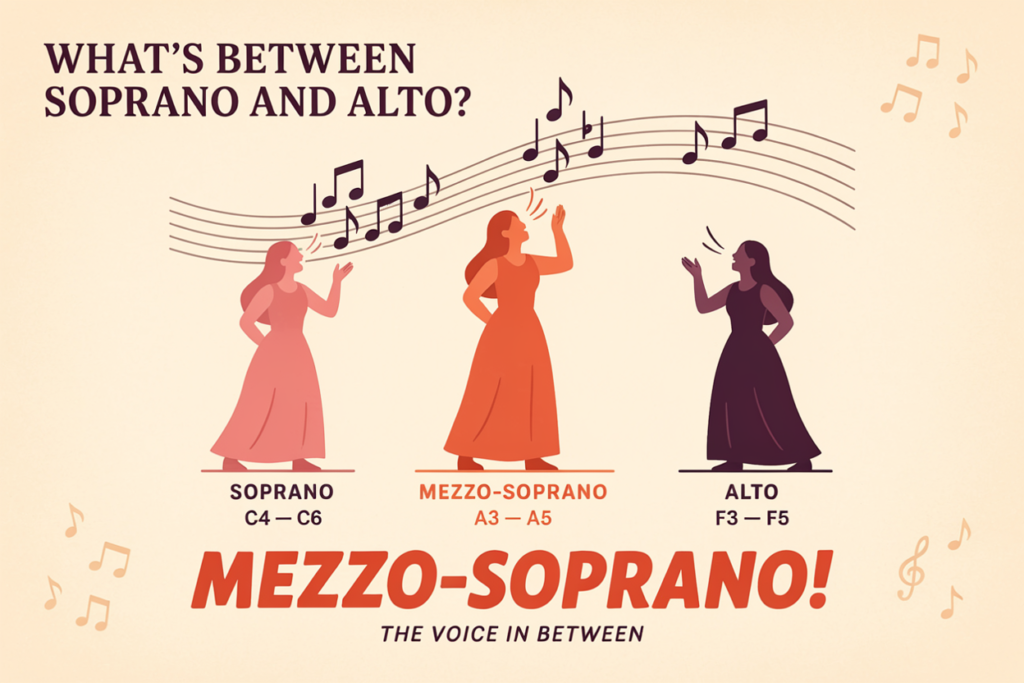
What Is Between Soprano and Alto?
The voice type between soprano and alto is mezzo-soprano. Mezzo-soprano is the middle female voice type: usually lower than soprano but higher than contralto. If you sing comfortably in the middle range and feel that soprano songs are too high while alto parts are sometimes too low, you may be a mezzo-soprano.
One important detail: alto is often a choir part, not always a formal solo voice type. In solo voice classification, the lower female voice type is usually called contralto. That means someone who sings alto in choir may actually be a mezzo-soprano, especially if their natural voice sits between soprano and lower female parts.
If you are trying to identify your own voice, start with a vocal range calculator and compare your results with a voice type range chart, but remember that comfort matters as much as the notes.
Mezzo-Soprano Is Between Soprano and Alto
The simple answer is mezzo-soprano. It sits between soprano and alto in many beginner explanations of female voices.
| Category | General Position | Simple Meaning |
|---|---|---|
| Soprano | Highest common female voice | Bright, higher voice |
| Mezzo-soprano | Between soprano and alto/contralto | Middle female voice |
| Alto | Choir part | Lower harmony part |
| Contralto | Lowest female solo voice type | Deepest common female category |
So if you are asking, “What voice is between soprano and alto?” the answer is mezzo-soprano. If you are asking about formal solo voice types, it is more accurate to say mezzo-soprano sits between soprano and contralto.
Female Voices From High to Low
Female voices are often explained from highest to lowest like this:
- Soprano
- Mezzo-soprano
- Contralto
In choir settings, you will often see parts labeled soprano and alto. Some choirs also split them into Soprano I, Soprano II, Alto I, and Alto II. A mezzo-soprano may be placed in Soprano II or Alto I depending on the song, the choir’s balance, and the singer’s comfort.
That is why the guide to female voice types is useful. It explains the broader categories, while the soprano voice page helps clarify what makes soprano different from the middle female voice.
What Is a Mezzo-Soprano?
A mezzo-soprano is the middle female voice type. The word “mezzo” means middle, so mezzo-soprano literally means something like “middle soprano.” It is generally lower than soprano but higher than contralto.
Mezzo-sopranos often have:
- A strong and comfortable middle range
- A warm tone
- Good flexibility between melody and harmony
- Some access to higher soprano-like notes
- More depth than a light soprano
- More upper movement than a true contralto
This is why many singers who feel “not quite soprano, not quite alto” discover that mezzo-soprano describes them better. The full guide to the mezzo-soprano voice explains this category in more detail.
Mezzo-Soprano vs Alto: What’s the Difference?
The difference between mezzo-soprano and alto can be confusing because people use the word “alto” in different ways.
| Term | Usually Means | Best Use |
|---|---|---|
| Mezzo-soprano | Middle female voice type | Solo/classical/pop voice classification |
| Alto | Lower choir part | Choral harmony assignment |
| Contralto | Lowest female solo voice type | Formal lower female voice classification |
A mezzo-soprano may sing alto in choir because many alto lines sit in a comfortable lower-middle range. But that does not automatically make the singer a contralto. It may simply mean the choir needs that voice on the alto harmony.
The article on soprano vs alto is helpful if you want a direct comparison between the two common choir labels, while the alto voice guide explains how the term is commonly used.
Alto vs Contralto: Why the Terms Get Confusing
Many beginners use “alto” and “contralto” as if they mean the same thing, but they are not always identical.
Alto usually describes a choral part. If you sing alto in choir, it means you are singing a lower harmony line compared with soprano. It does not always prove your natural voice type.
Contralto is a lower female solo voice type. True contraltos usually have a naturally low tessitura, darker tone, and comfortable low range. They are less common than sopranos and mezzo-sopranos.
This is why not everyone assigned alto should call themselves contralto. The guide on alto vs contralto explains the difference more clearly.
How to Know If You Are Between Soprano and Alto
You may be a mezzo-soprano if several of these feel true:
- High soprano songs feel possible but tiring
- Very low alto parts feel heavy or uncomfortable
- Your middle range feels strongest
- Your tone feels warm rather than very bright
- You can sing some melody lines and some harmony parts
- You feel more comfortable slightly below many soprano songs
- Your voice does not feel naturally as low as a contralto
A singing voice test can help you explore your usable range, while a pitch detector can help you check the actual notes you are singing. If you want more detail about your pitch behavior, a voice analyzer can also help you observe patterns in your voice.
Range Is Helpful, But Tessitura Matters More
Range is useful, but it is not the whole answer. Your vocal range is the full span from your lowest note to your highest note. Your tessitura is the part of your range where your voice feels most comfortable and natural.
For example, you may be able to reach a few high soprano notes, but if singing there for a whole song feels tiring, that may not be your natural center. You may also be able to sing a few low alto notes, but if they sound weak or forced, they may not define your voice type.
The guide on what tessitura means explains why comfort and consistency matter more than one impressive high or low note.
Can a Mezzo-Soprano Sing Soprano or Alto?
Yes. A mezzo-soprano can often sing some soprano parts and some alto parts, depending on the song, key, training, and choir arrangement.
In choir, a mezzo-soprano may sing:
- Soprano II if the line is not too high
- Alto I if the line sits in a comfortable middle-low range
- Melody in pop songs
- Harmony in lower arrangements
- Musical theater songs that need warmth and flexibility
The best part is not always the one with the highest or lowest notes. The best part is the one that fits your tone, comfort, and musical role.
Common Mistakes When Finding Your Voice Type
Avoid these mistakes:
- Assuming your choir part is automatically your voice type
- Judging your voice from one high note
- Judging your voice from one low note
- Calling yourself alto only because soprano feels too high
- Calling yourself soprano only because you can reach high notes
- Ignoring tessitura and comfort
- Copying another singer’s key without transposing
- Forcing your voice into a label too early
A better approach is to test your range, notice where your voice feels comfortable, compare that with standard categories, and learn how your voice behaves over time. The guide on how to find your voice type is a good next step after you understand the basic soprano-mezzo-alto order.
FAQ
What voice type is between soprano and alto?
The voice type between soprano and alto is mezzo-soprano. It is the middle female voice type.
Is mezzo-soprano higher than alto?
Yes. Mezzo-soprano generally sits higher than alto or contralto, but lower than soprano.
Is mezzo-soprano lower than soprano?
Yes. Mezzo-soprano is usually lower than soprano and often has a warmer middle range.
Is alto the same as contralto?
Not always. Alto is often a choir part, while contralto is a lower female solo voice type.
Can a mezzo-soprano sing alto?
Yes. Many mezzo-sopranos sing alto parts in choir, especially Alto I or lower harmony lines that sit comfortably.
Can a mezzo-soprano sing soprano?
Sometimes. A mezzo-soprano may sing some soprano parts, especially Soprano II, but very high soprano lines may feel tiring.
How do I know if I am mezzo-soprano?
You may be mezzo-soprano if your middle range feels strongest, soprano songs feel too high, and low alto parts are possible but not your natural center.
What is the order of female voices?
The common solo order from high to low is soprano, mezzo-soprano, and contralto. In choir, the common parts are soprano and alto.
Is mezzo-soprano common?
Yes. Mezzo-soprano is a common female voice type and often fits singers who feel between soprano and alto.
Should I use range or comfort to find my voice type?
Use both, but comfort is very important. Your tessitura shows where your voice works best, not just the highest or lowest note you can reach.

Benjamin Parker is a voice classification and singing analysis writer at VoiceTypeTest. He focuses on vocal type identification, vocal range analysis, pitch recognition, and singing education tools for vocalists, musicians, choir singers, and beginners.