
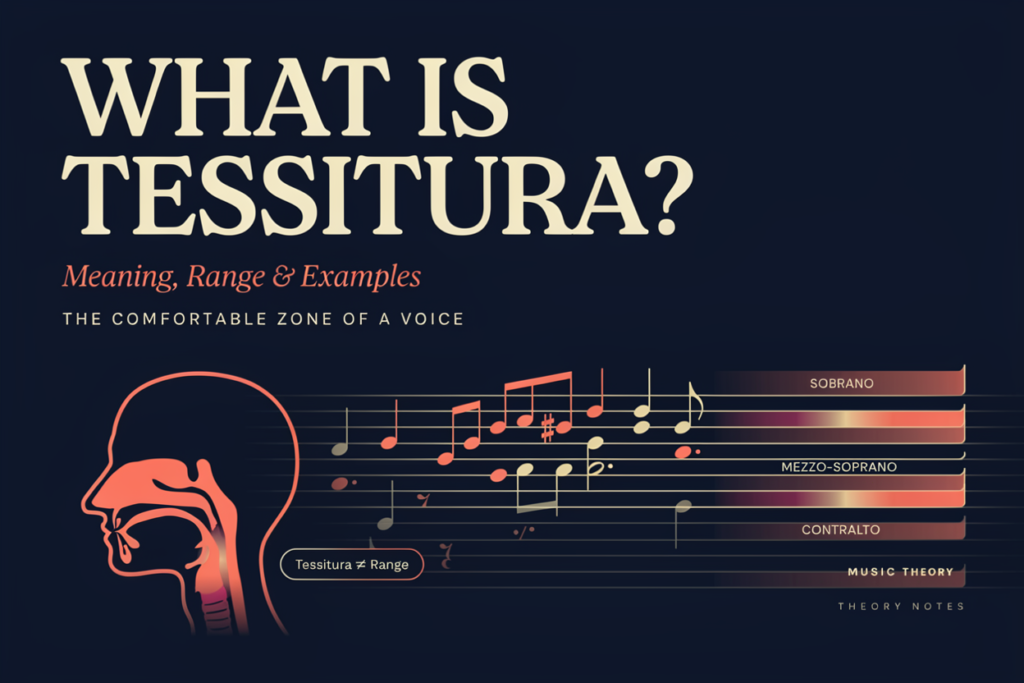
Tessitura is the part of a singer’s vocal range where the voice feels most comfortable, sounds most natural, and can be sustained with consistent quality. Unlike vocal range, which includes every note a singer can produce from the lowest to the highest, tessitura describes the practical working area where the voice performs best.
Understanding tessitura helps singers choose suitable songs, identify voice types more accurately, and develop healthier vocal technique.
What Is Tessitura in Singing?
Tessitura refers to the collection of notes that a singer uses most frequently in a piece of music and where their voice maintains the strongest tone, easiest control, and best resonance.
A singer may be able to reach very high or very low notes, but those extreme notes do not necessarily represent their tessitura. The most important part of a voice is often the area where it can stay for a long time without tension or fatigue.
For example, a tenor might be able to briefly sing very high notes, but if the voice is strongest and most comfortable in the middle-to-upper range, that area represents the tenor’s tessitura.
How Is Tessitura Different From Vocal Range?
Vocal range and tessitura are related, but they describe different parts of a singer’s ability.
| Feature | Vocal Range | Tessitura |
|---|---|---|
| Meaning | The complete span of notes a singer can produce | The comfortable and sustainable area of the voice |
| Includes | Lowest and highest possible notes | Frequently used and strongest notes |
| Purpose | Measures vocal limits | Helps determine practical singing ability |
| Changes with | Training, technique, development | Training, vocal maturity, and repertoire |
| Used for | General voice measurement | Song, role, and voice classification decisions |
A singer’s highest note does not automatically determine their voice type. Tessitura, tone quality, vocal weight, and registration are also important factors.
You can learn more about the relationship between these concepts in our guide about voice type and vocal range differences.
Why Is Tessitura Important for Singers?
Tessitura Helps Identify Your True Voice Type
Voice classification systems such as soprano, mezzo-soprano, tenor, baritone, and bass use tessitura as one of the important factors.
Two singers may have the same vocal range but different voice classifications because their comfortable singing areas and vocal qualities are different.
For example, a singer who can reach the same notes as a tenor may still have a baritone tessitura if the middle range feels stronger and more natural.
Understanding your voice category requires looking beyond range alone. A detailed voice type classification guide explains how range, tone, and vocal characteristics work together.
Tessitura Affects Vocal Health and Endurance
Singing repeatedly outside your natural tessitura can create unnecessary vocal stress. Professional singers usually select music that sits comfortably within their strongest vocal area.
A song may contain notes inside your range but still feel difficult because most phrases remain outside your comfortable tessitura.
Tessitura Guides Song and Role Selection
Composers and vocal coaches consider tessitura when assigning musical roles, especially in opera. A role is not judged only by its highest or lowest note but by where most of the singing occurs.
This is why opera classifications consider tessitura alongside vocal color and range. You can explore more about this in the overview of operatic voice types.
How Do Singers Find Their Tessitura?
Test Your Comfortable Singing Area
Finding tessitura requires more than discovering your highest and lowest notes. A singer should observe:
- Where the voice feels relaxed
- Which notes have the clearest tone
- Where breathing feels natural
- Which notes can be sustained comfortably
A vocal range test can help identify your overall note span, but tessitura requires paying attention to comfort and consistency.
Notice Where Your Voice Sounds Strongest
The best indication of tessitura is often the area where your voice naturally resonates. Notes in this area usually require less effort and maintain better tone quality.
Regular vocal practice and exercises can also improve awareness of your natural singing zone. Learn more about effective voice exercises for singers.
Tessitura Examples by Voice Type
| Voice Type | General Tessitura Characteristics |
| Soprano | Higher comfortable singing area with bright resonance |
| Mezzo-soprano | Middle female range with warm and balanced tone |
| Contralto/Alto | Lower female tessitura with deeper color |
| Tenor | Higher male tessitura with strong upper resonance |
| Baritone | Middle male tessitura with rich vocal weight |
| Bass | Lowest male tessitura with deep resonance |
These are general descriptions. Individual singers can have different tessituras depending on training, anatomy, and vocal development.
You can compare different voice categories through a complete voice type range chart.
Can Tessitura Change Over Time?
Yes, a singer’s tessitura can change as the voice develops. Training, improved technique, age, and stronger breath support can expand the area where a singer feels comfortable.
However, natural vocal characteristics usually remain consistent. A singer may extend their range while their most comfortable tessitura stays relatively similar.
Tessitura vs Range vs Voice Type
Tessitura answers the question: “Where does my voice work best?”
Vocal range answers: “What notes can my voice produce?”
Voice type answers: “What category best describes my vocal characteristics?”
These three concepts work together. A complete voice assessment considers all of them rather than focusing only on one measurement.
Frequently Asked Questions
What is tessitura in simple terms?
Tessitura is the part of your singing range where your voice feels easiest, sounds strongest, and can perform for longer periods without strain.
Is tessitura the same as vocal range?
No. Vocal range includes every note you can sing, while tessitura describes the notes where your voice performs most comfortably.
Why is tessitura important in opera?
Tessitura helps determine whether a singer is suitable for a role because most operatic singing happens within a specific comfortable range, not only at extreme notes.
Can a singer’s tessitura change?
Yes. Training, technique, vocal maturity, and improved coordination can influence tessitura over time.
How can I find my natural tessitura?
You can identify your tessitura by noticing which notes feel relaxed, produce consistent tone, and remain comfortable during longer singing sessions.

Benjamin Parker is a voice classification and singing analysis writer at VoiceTypeTest. He focuses on vocal type identification, vocal range analysis, pitch recognition, and singing education tools for vocalists, musicians, choir singers, and beginners.