
Voice frequency range describes the frequencies produced by the human
voice, measured in Hertz (Hz). It is mainly determined by how fast the
vocal folds vibrate during sound production. A lower vibration rate
creates a lower pitch, while a faster vibration rate creates a higher
pitch.
The human voice is not limited to one frequency. Speaking voices usually
occupy a narrower range, while singing voices can cover a much wider
frequency spectrum depending on vocal training, voice type, and
technique.
What Is Voice Frequency?
Voice frequency is the number of vocal fold vibrations that occur each
second. It is measured in Hertz (Hz), where one Hertz equals one
vibration per second.
The main measurement used in voice science is the fundamental frequency
(F0). Fundamental frequency represents the primary vibration rate of the
vocal folds and is closely related to the pitch we hear.
For example: – A voice vibrating at 100 Hz produces a lower pitch. – A
voice vibrating at 250 Hz produces a higher pitch.
However, frequency is only one part of voice. Tone color, resonance,
vocal technique, and harmonics also influence how a voice sounds.
What Is the Normal Human Voice Frequency Range?
The average speaking frequency range differs between men, women, and
children.
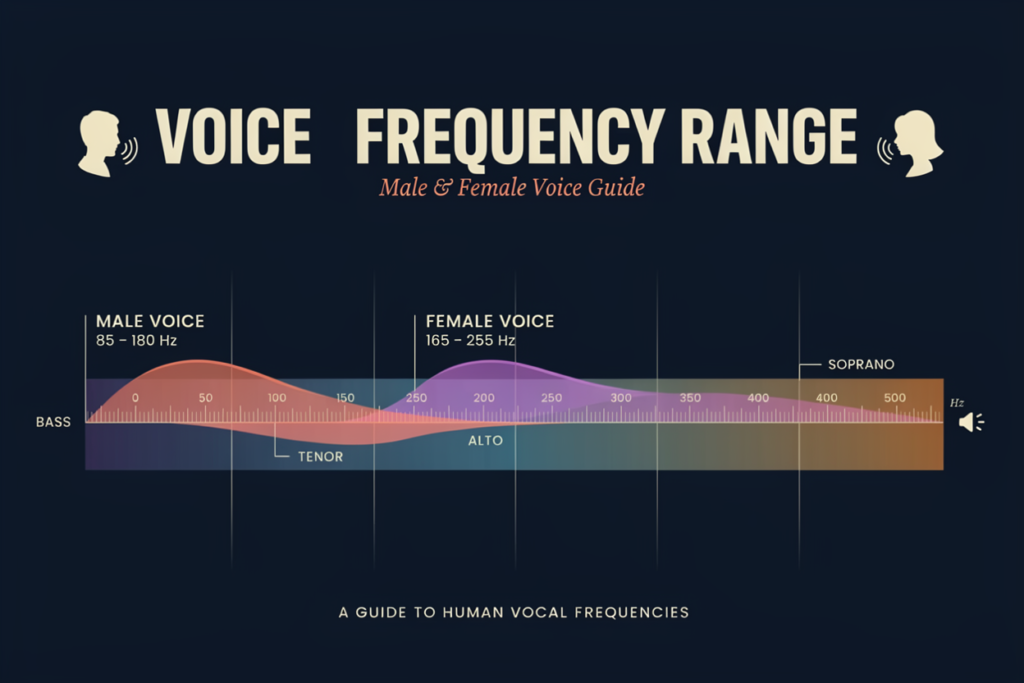
Voice Category Approximate Speaking Frequency;
Adult male voice Around 85–180 Hz
Adult female voice Around 165–255 Hz
Children’s voices Often above 250 Hz
These values are general averages. Individual voices can fall outside
these ranges because vocal anatomy, age, language, and training all
affect frequency.
A person with a deep voice usually has a lower fundamental frequency
because longer and thicker vocal folds vibrate more slowly. Higher
voices generally result from shorter, thinner vocal folds vibrating
faster.
How Does Voice Frequency Differ Between Speaking and Singing?
Speaking Voice Frequency
Normal speech uses a relatively small frequency area because people
usually communicate within a comfortable vocal zone.
During conversation, the voice constantly changes pitch for emotion,
emphasis, and meaning, but it usually stays near a person’s natural
speaking frequency.
Singing Voice Frequency
Singing requires control over a much wider frequency range. Trained
singers can produce notes that extend far beyond their normal speaking
frequency.
For example:
Voice Type Approximate Singing Range
Bass E2–E4
Baritone A2–A4
Tenor C3–C5
Contralto E3–E5
Mezzo-soprano A3–A5
Soprano C4–C6
These note ranges represent common classifications, but individual
singers may have wider or narrower abilities.
You can compare how voice categories differ by exploring the voice type
and vocal range
relationship.
Voice Frequency Range by Voice Type
Voice classification does not depend only on frequency. Professional
classification considers range, tessitura, vocal weight, and tone
quality.
Voice Type General Frequency Area;
Bass Lower frequencies with deep resonance
Baritone Mid-low male frequency range
Tenor Higher male frequency range
Contralto Lowest female frequency category
Mezzo-soprano Middle female frequency category
Soprano Highest common female frequency category
A singer’s highest frequency does not automatically determine their
voice type. The area where their voice feels strongest and most
comfortable, known as tessitura, is equally important.
Learn more about this concept in the guide explaining how tessitura
affects singing.
What Determines a Person’s Voice Frequency?
Vocal Cord Length and Thickness
The size and structure of the vocal folds strongly influence fundamental
frequency.
Longer and thicker vocal folds usually vibrate more slowly, creating
lower frequencies. Shorter and thinner vocal folds generally create
higher frequencies.
Age and Hormonal Changes
Voice frequency changes naturally throughout life. During puberty,
hormonal changes affect vocal fold size, especially in males, often
causing the speaking frequency to decrease.
Children typically have higher voices because their vocal folds are
smaller.
Training and Vocal Technique
Singing training does not completely change a person’s natural anatomy,
but it can improve control over frequency. Singers learn to produce
higher and lower notes more efficiently through breath support,
resonance, and vocal coordination.
Voice Frequency vs Vocal Range: What Is the Difference?
Voice frequency and vocal range are connected but not identical.
Term Meaning
Voice frequency The vibration rate of the vocal
folds measured in Hz
Vocal range The complete set of notes a singer
can produce
Tessitura The most comfortable and
sustainable singing area
A singer may have a wide vocal range but a smaller comfortable
tessitura. Similarly, two singers can reach the same notes but have
different voice classifications.
A complete understanding of your voice requires looking at multiple
factors, not just frequency. A voice type range
chart can help
compare these characteristics.
How Is Voice Frequency Measured?
Voice frequency can be measured using acoustic analysis tools that
detect vocal vibrations and calculate the fundamental frequency.
Common measurement methods include: – Microphone-based pitch analysis –
Acoustic voice software – Professional voice laboratory equipment
At-home voice tests can provide useful estimates, but they may not match
laboratory measurements because microphone quality, background noise,
and singing technique can affect results.
If you want to understand your overall vocal classification, learning
how to find your voice
type can
provide additional context.
Why Voice Frequency Matters for Singers
Understanding frequency helps singers: – Identify their natural vocal
range – Choose suitable songs – Monitor vocal development – Improve
pitch accuracy – Understand voice classification
Frequency knowledge is especially useful when combined with vocal
exercises, proper technique, and awareness of vocal health.
Frequently Asked Questions
What is the average frequency range of the human voice?
The average speaking voice frequency is approximately 85–180 Hz for
adult males and around 165–255 Hz for adult females. Individual voices
vary depending on anatomy, age, and vocal habits.
What Hz is considered a deep voice?
Deep voices typically have lower fundamental frequencies, often below
the average male speaking range. Many deep male voices are associated
with frequencies around 85–120 Hz.
What Hz range is a female voice?
Adult female speaking voices commonly fall around 165–255 Hz, although
singers can produce much higher frequencies during singing.
Is voice frequency the same as vocal range?
No. Voice frequency measures vocal fold vibration speed, while vocal
range describes the complete span of notes a person can sing.
Can singers increase their voice frequency range?
Singers can often extend their usable range through training, breath
control, and technique, although natural anatomy influences the limits
of each voice.

Benjamin Parker is a voice classification and singing analysis writer at VoiceTypeTest. He focuses on vocal type identification, vocal range analysis, pitch recognition, and singing education tools for vocalists, musicians, choir singers, and beginners.