
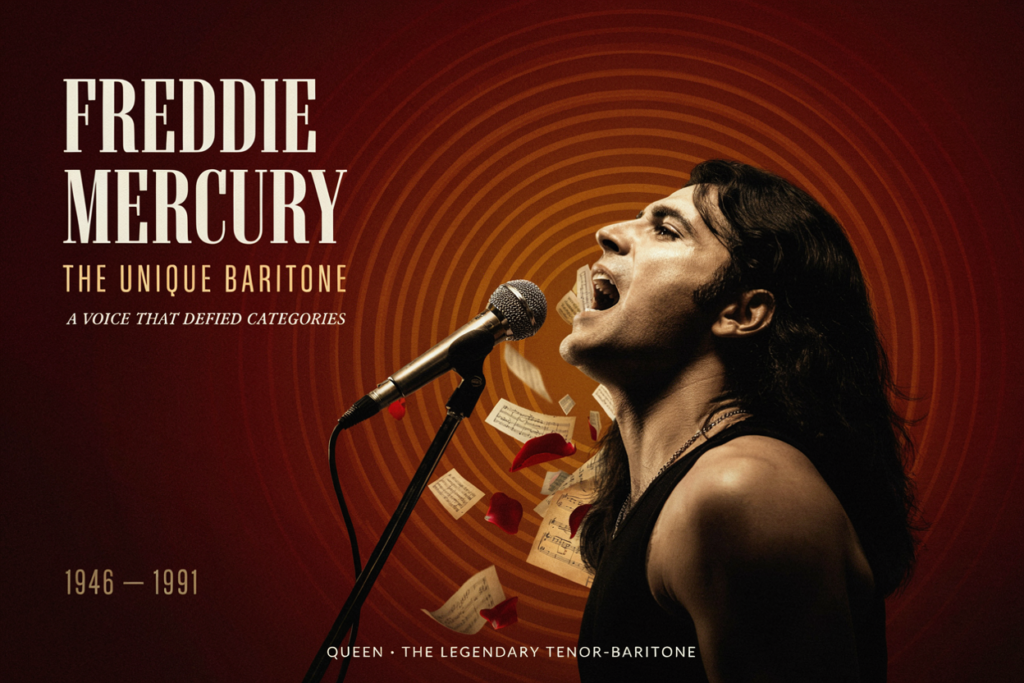
Freddie Mercury is best understood as a baritone or high baritone with impressive tenor-range extension. Many listeners call him a tenor because he sang high rock lines with power, brightness, and confidence. However, his speaking pitch, vocal weight, and strong lower-middle resonance support the idea that his natural voice sat closer to baritone than a typical tenor.
The important point is that vocal range is not the same as voice type. A singer can reach high notes without being a tenor, and a tenor can have a darker tone. Voice type depends on range, tessitura, passaggio, vocal weight, tone, and where the voice feels most natural. If you want to compare your own voice with standard categories, start with the vocal range calculator and then check your results against a male vocal range chart.
What Voice Type Was Freddie Mercury?
Freddie Mercury was most likely a baritone or high baritone who could sing convincingly in tenor territory. His voice had a powerful midrange, a dramatic upper extension, and a bright rock belt that made him sound higher than many baritones.
| Vocal Factor | What It Suggests |
|---|---|
| Strong lower-middle voice | Baritone-like color |
| High rock belts | Tenor-range extension |
| Powerful stage projection | Rock technique and resonance |
| Flexible register control | Advanced vocal coordination |
| Wide usable range | Ability, not voice type by itself |
A careful answer is better than a simple label: Freddie’s natural vocal identity leaned baritone, but his performance range and rock style allowed him to sing many parts that felt tenor-like.
Why Freddie Mercury Is Hard to Classify
Freddie Mercury is difficult to classify because rock singers do not use the voice the same way classical singers do. Opera voice types are based on fach, tessitura, passaggio, vocal weight, projection, and role suitability. Rock singers use microphones, distortion, studio layering, dramatic phrasing, live energy, and genre-specific tone.
Freddie’s voice could sound full and dark in one phrase, then bright and cutting in the next. He also used theatrical delivery, rhythmic attack, and strong vowel shaping to make notes sound larger than they might appear on paper.
This is why a page on voice type vs vocal range is useful. A singer’s highest note does not automatically decide the voice type.
Freddie Mercury’s Vocal Range vs Voice Type
Freddie Mercury is often discussed for his wide vocal range, but the exact note extremes vary depending on the source, recording, and whether the notes come from studio layers, live singing, or special vocal effects. For voice classification, the more useful question is: where did his voice sound most natural, repeatable, and resonant?
That is where tessitura matters. Tessitura means the part of the range where a singer can perform comfortably and musically for longer periods. A singer might touch a very high note for drama, but that does not mean the high note represents the natural center of the voice. The guide on what tessitura means explains why comfort and consistency matter more than one extreme note.
Freddie’s most recognizable sound often came from a strong, ringing middle and upper-middle range, supported by a darker, weightier core. That balance is why many analysts describe him as a high baritone rather than a straightforward tenor.
Was Freddie Mercury a Baritone?
The baritone argument is strong because Freddie had a rich speaking voice, a powerful lower-middle register, and a vocal color that often sounded fuller than a typical light tenor. Baritones usually sit between bass and tenor, with strength in the middle voice. Freddie’s tone often had that center of gravity.
A well-known acoustic study also analyzed Freddie’s voice and found his median speaking fundamental frequency to be around 117.3 Hz, which supports a baritone-like speaking pitch. Speaking pitch alone cannot fully classify a singing voice, but it is useful evidence when combined with his vocal weight and timbre.
For broader context, see the guide to male voice classification and the page on baritone vocal range.
Why Some People Call Freddie Mercury a Tenor
Many people call Freddie Mercury a tenor because of how high and bright he could sing in Queen’s music. Songs such as “Somebody to Love,” “We Are the Champions,” and “Don’t Stop Me Now” include phrases that sit high and require strong energy.
That does not automatically make him a tenor. Rock singing often pushes the voice into an intense upper range through mix, vowel modification, resonance, and microphone support. A skilled baritone can sing high notes, especially in a amplified pop or rock setting.
The debate is easier to understand when you compare tenor vocal range with tenor vs baritone. Freddie could access tenor-like territory, but his natural vocal weight and color still point toward baritone or high baritone.
What Made Freddie Mercury’s Voice Unique?
Freddie Mercury’s voice was not only famous because of range. His real strength was expression, control, and theatrical force.
| Vocal Trait | Why It Mattered |
|---|---|
| Vibrato | Added excitement and emotional intensity |
| Resonance | Made the voice sound large and commanding |
| Grit and edge | Created rock power and urgency |
| Dynamic shifts | Let him move from soft to explosive moments |
| Register control | Helped him move between colors quickly |
| Rhythmic phrasing | Made lines feel dramatic and alive |
| Stage presence | Turned vocal delivery into performance |
His voice could be elegant, rough, playful, operatic, intimate, or explosive depending on the song. That range of character is one reason he remains one of rock’s most studied singers.
Freddie Mercury Compared With Other Singers
Freddie Mercury is often compared with other powerful singers, but his vocal identity was unique.
Compared with Bruno Mars’ voice type, Freddie had a heavier, more theatrical rock sound, while Bruno is usually discussed for lighter high male pop vocals, agility, and bright upper-range ease.
Compared with a typical tenor, Freddie had enough high extension to sound tenor-like, but his core tone was darker and weightier. Compared with a typical baritone, he sang higher with more dramatic upper-range energy than many baritones.
Compared with Whitney Houston’s voice type, the categories are different, but both singers show how power, range, resonance, and musical authority can make a voice feel larger than a simple label.
Can You Sing Like Freddie Mercury?
You can study Freddie Mercury’s phrasing, energy, vowel shaping, rhythm, and stage confidence, but you should not force his high belts or gritty effects. Rock distortion and vocal edge require control. If you push from the throat, you can strain your voice quickly.
A safer goal is to understand your own range first. Use a singing voice test to explore your comfortable singing area, a voice analyzer to observe vocal behavior, and a voice frequency test if you want to explore pitch and speaking-frequency patterns. During practice, a pitch detector or vocal pitch monitor can help you track notes without guessing.
The goal is not to become Freddie. The goal is to build your own healthy version of range, confidence, and expression.
Common Mistakes When Analyzing Freddie Mercury’s Voice
Avoid these mistakes:
- Assuming high notes automatically mean tenor
- Assuming speaking pitch alone proves the whole voice type
- Judging his voice from one song or one live clip
- Confusing vocal range with tessitura
- Ignoring rock style, microphones, and studio production
- Treating grit or distortion as natural voice type
- Copying rough effects without vocal control
- Ranking singers by voice type instead of musical skill
A better analysis looks at the whole instrument: tone, comfort, range, vocal weight, style, and how the singer actually used the voice.
FAQ
What voice type was Freddie Mercury?
Freddie Mercury is best understood as a baritone or high baritone with strong tenor-range extension.
Was Freddie Mercury a baritone or tenor?
He is often described as a baritone or high baritone, though many listeners hear tenor-like qualities because of his high rock singing.
What was Freddie Mercury’s vocal range?
His range is widely discussed, but exact note claims vary by source and performance. Range alone does not determine voice type.
Why did Freddie Mercury sound like a tenor?
He could sing high rock lines with bright resonance, strong mix, and dramatic energy, which made parts of his voice sound tenor-like.
Was Freddie Mercury a high baritone?
High baritone is a reasonable practical description because his voice had baritone weight but strong access to higher singing territory.
What made Freddie Mercury’s voice unique?
His voice combined resonance, vibrato, grit, dynamic contrast, theatrical phrasing, and exceptional stage presence.
Is vocal range the same as voice type?
No. Vocal range is the span of notes a singer can produce. Voice type also depends on tessitura, passaggio, tone, vocal weight, and comfort.
Can I sing like Freddie Mercury?
You can study his phrasing and energy, but do not force high belts or gritty effects. Build your own voice safely.
How can I find my own male voice type?
Test your vocal range, notice your comfortable tessitura, compare your results with male voice categories, and avoid judging your type from one extreme note.

Benjamin Parker is a voice classification and singing analysis writer at VoiceTypeTest. He focuses on vocal type identification, vocal range analysis, pitch recognition, and singing education tools for vocalists, musicians, choir singers, and beginners.