
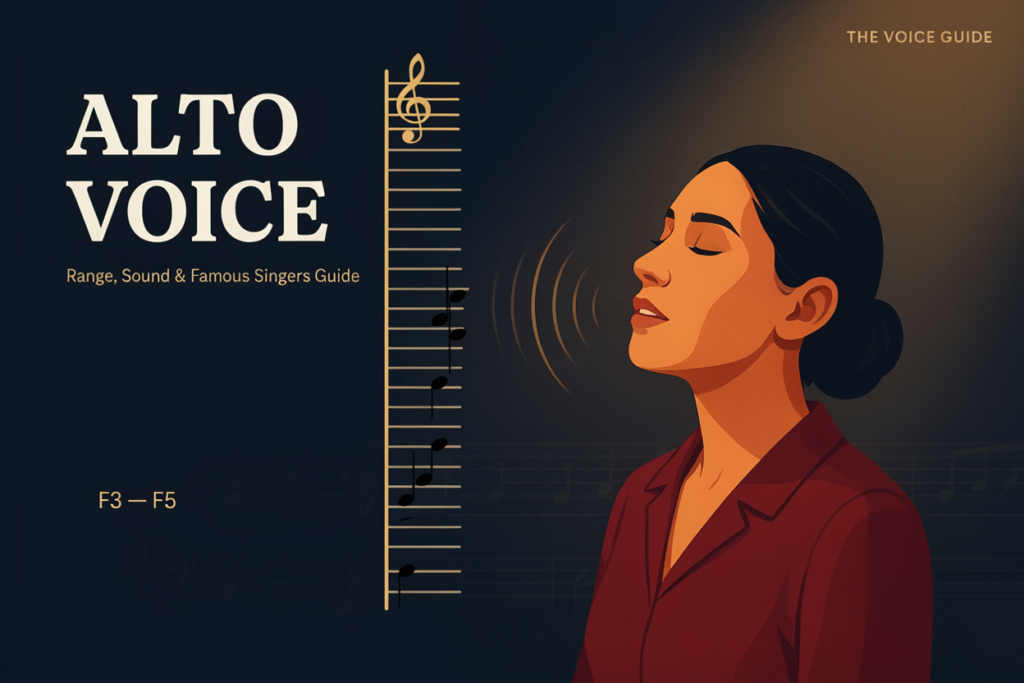
An alto voice usually means the lower female part in choir. Altos often sing lower harmony lines that support the soprano melody and help the music sound fuller, warmer, and more balanced. In many choirs, alto is a practical singing part rather than a strict solo voice type.
The most important distinction is this: alto is not always the same as contralto. Alto often describes a choir role, while contralto is the lowest common female solo voice type. Some contraltos sing alto, but many choir altos are actually mezzo-sopranos.
If you are unsure whether alto fits your voice, start with a test your singing voice approach: check your comfortable range, notice whether lower harmony feels natural, and pay attention to whether high soprano lines feel tiring or strained.
What Is an Alto Voice?
An alto voice is usually the lower female choir part. Alto singers often sing harmony below soprano lines. Their parts may sound warm, grounded, and supportive.
| Term | What It Usually Means | Simple Explanation |
|---|---|---|
| Soprano | Higher female part/type | Often melody or upper harmony |
| Mezzo-soprano | Middle female voice type | Between soprano and contralto |
| Alto | Lower choir part | Often lower harmony |
| Contralto | Lowest female solo type | Naturally low female voice |
Alto is not a weaker or easier part. In many songs, alto lines require strong pitch control because they do not always follow the main melody.
Alto as a Choir Part
In choir, alto usually sits below soprano. Alto lines often provide the inner harmony that makes a choral arrangement sound rich. Instead of singing the most obvious tune, altos may hold notes that support the chord structure.
Some choirs divide alto into Alto I and Alto II. Alto I often sits slightly higher and may suit mezzo-sopranos with a comfortable middle-low range. Alto II may sit lower and can fit singers with deeper voices or stronger lower harmony.
Choir placement can depend on many things: the arrangement, the number of singers, blend, balance, and the director’s needs. That is why the guide to choir voice parts is useful. It explains why a choir label may not always equal your natural solo voice type.
Alto Voice vs Contralto
Alto and contralto are often confused, but they are not always the same.
Alto usually means a lower female choir part. Contralto is a lower female solo voice type. A contralto usually has a naturally low tessitura, darker tone, and comfortable low range.
That means a singer can sing alto in choir without being a true contralto. Many altos are mezzo-sopranos because their voices sit comfortably in middle-low harmony parts. Some altos are contraltos, but not all.
The guide on alto vs contralto explains this difference in more detail. If you think your voice may be naturally very low, compare your comfort zone with the contralto vocal range guide.
What Does an Alto Voice Sound Like?
An alto voice often sounds warm, grounded, supportive, and steady. In choir, altos may create depth under the soprano line. In solo singing, a lower female voice may sound rich, dark, smooth, or full depending on the singer.
Common alto qualities include:
- Comfortable lower harmony
- Strong middle-low range
- Warm or grounded tone
- Good blend with other voices
- Strong pitch independence
- Ability to support harmony without relying on melody
- Lower lines that feel natural rather than forced
Not every alto sounds dark or heavy. Some altos have clear, bright tones but still feel more comfortable below soprano lines.
Alto Vocal Range
Alto range varies by choir, singer, and style. Many alto parts sit in the lower female range, but they often overlap with mezzo-soprano and contralto areas. This is why range alone can be confusing.
The key question is not, “Can I sing one low note?” It is, “Can I sing lower harmony clearly, comfortably, and repeatedly?”
A useful alto range should feel:
- Clear
- Stable
- Comfortable in phrases
- Not forced downward
- Strong enough to hold harmony
- Repeatable across different songs
Some singers assigned alto may actually match the mezzo-soprano vocal range better than true contralto range. That is normal, especially in choirs where parts are assigned for balance.
Alto vs Soprano and Mezzo-Soprano
Soprano is generally higher than alto. Alto usually sings lower harmony, while soprano often sings melody or upper harmony. The article on why soprano is higher than alto gives a simple explanation of that difference.
Mezzo-soprano sits between soprano and contralto. Many mezzo-sopranos sing alto parts in choir, especially Alto I. This is why some singers feel they are not fully soprano but also not naturally low enough to be contralto.
The guide on mezzo-soprano vs contralto is helpful if you are comparing middle and lower female voices. For a broader overview, the female voice types page explains how soprano, mezzo-soprano, alto, and contralto fit together.
How to Know If Alto Fits Your Voice
You may fit alto well in choir if several of these feel true:
- Lower harmony feels comfortable
- High soprano lines feel tiring
- Your middle-low range feels strong
- You can hold harmony without needing the melody
- Your low notes are clear, not forced
- Your voice blends well under higher voices
- You feel more stable in supportive lower lines
A voice analyzer can help you observe pitch behavior, and a check voice frequency tool can add extra context if you are curious about low pitch. Still, comfort and repeatability matter more than one number or one note.
Range Is Not Enough: Comfort and Voice Type
One low note does not make someone alto or contralto. A singer may reach low notes but feel weak, breathy, or strained there. Another singer may sing alto in choir because the arrangement fits, even if their natural solo voice type is mezzo-soprano.
This is why the concept of voice type vs vocal range matters. Vocal range is the span of notes you can sing, but voice type also includes tessitura, tone, passaggio, weight, and comfort.
Do not force your voice lower to sound like an alto. A healthy alto sound should feel natural, not pressed or artificially darkened.
Famous Low Female Voices and Listening Context
Listening to low female voices can help you understand the difference between alto-like choir parts and true contralto voices. However, examples should be used carefully. Pop singers may use microphones, studio effects, key changes, and style choices that make voice labels less exact.
The guide to famous contralto singers can help you hear deeper female voice colors. Use examples for listening practice, not as strict rules for your own label.
Common Mistakes About Alto Voices
Avoid these common mistakes:
- Thinking alto means a weak singer
- Thinking alto is always the same as contralto
- Choosing alto from one low note
- Forcing low notes to sound darker
- Thinking altos cannot sing melody
- Assuming soprano is better because it is higher
- Ignoring comfort and tessitura
- Treating choir placement as a final diagnosis
Alto singing can require strong musicianship. Holding harmony, blending well, and staying in tune on a non-melody line can be challenging and valuable.
If you want to build your voice safely, use voice exercises for singers that improve control without forcing your range. Your range and comfort may also develop over time, so the article on whether voice type can change is a useful follow-up.
FAQ
What is an alto voice?
An alto voice is usually the lower female choir part. Altos often sing lower harmony lines below soprano parts.
Is alto a voice type or choir part?
Alto is most often used as a choir part. In solo voice classification, contralto is the more specific lower female voice type.
Is alto lower than soprano?
Yes. Alto is generally lower than soprano in choir arrangements.
Is alto the same as contralto?
Not always. Some contraltos sing alto, but many choir altos are mezzo-sopranos or singers assigned to a lower harmony part.
What is the range of an alto voice?
Alto range varies by choir and singer. It usually sits lower than soprano parts and may overlap with mezzo-soprano and contralto ranges.
Can altos sing high notes?
Yes. Some altos can sing high notes, but very high soprano lines may feel tiring or less natural.
Can altos sing melody?
Yes. Altos can sing melody, especially in solo songs or arrangements where the melody sits lower. In choir, they often sing harmony.
How do I know if I am an alto?
You may fit alto if lower harmony feels comfortable, high soprano lines feel tiring, and your middle-low range feels strong and clear.
Is alto easier than soprano?
No. Alto is not automatically easier. Alto parts often require strong harmony skills and pitch independence.
Can my voice change from alto to soprano?
Your range and technique can develop with training, but voice type depends on natural comfort, tessitura, tone, and vocal structure. Do not force your voice into a higher label.

Benjamin Parker is a voice classification and singing analysis writer at VoiceTypeTest. He focuses on vocal type identification, vocal range analysis, pitch recognition, and singing education tools for vocalists, musicians, choir singers, and beginners.