
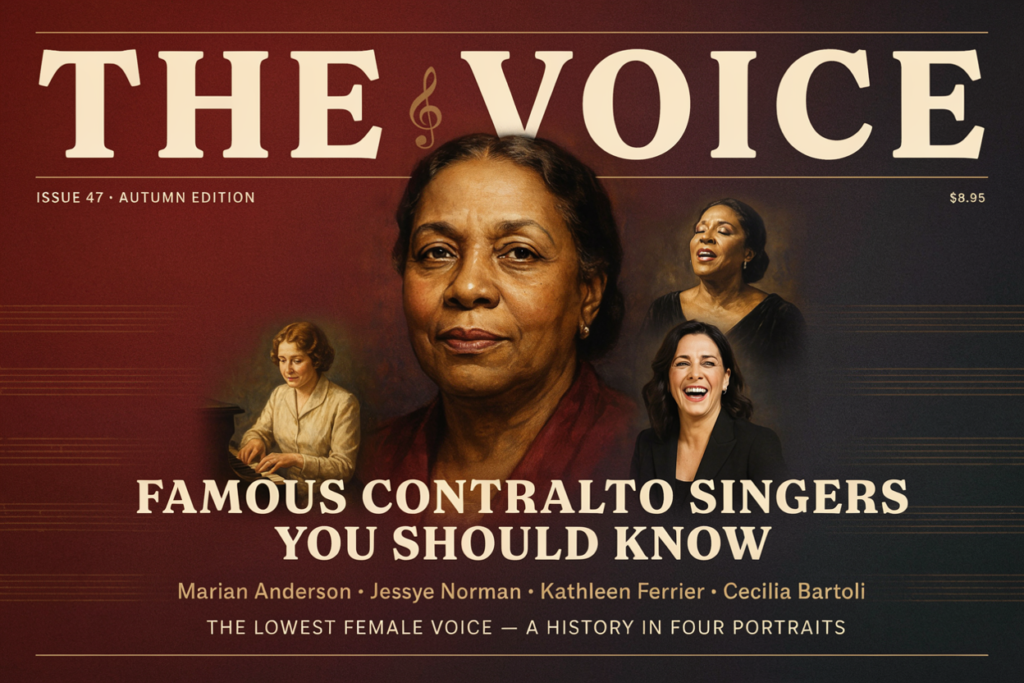
Famous contralto singers are vocalists recognized for one of the rarest
female classical voice types. The contralto voice is known for its deep,
rich tone, strong lower register, and dark vocal color. Unlike simply
having a low singing range, a true contralto voice is defined by a
combination of range, tessitura, resonance, and vocal character.
Legendary contraltos such as Marian Anderson, Kathleen Ferrier, and Ewa
Podleś became famous because of their unique vocal qualities, artistic
interpretation, and ability to bring emotional depth to their
performances.
Who Are the Most Famous Contralto Singers?
Some of the most famous contralto singers include Marian Anderson,
Kathleen Ferrier, Ewa Podleś, Ernestine Schumann-Heink, and Maureen
Forrester.
These singers represent different styles of contralto singing, from
opera and classical art songs to concert performances. Their voices
demonstrated that a lower female voice can have both power and
expressive beauty.
A famous contralto is not identified only by singing low notes. The most
important factors include vocal color, comfortable singing area, and the
natural quality of the voice.
What Is a Contralto Voice?
A contralto is the lowest standard female classical voice type.
Contraltos usually have a darker, warmer sound compared with sopranos
and mezzo-sopranos.
A typical contralto range is often described around E3–E5, although
individual singers may have wider ranges.
A contralto voice is usually recognized by:
- Deep vocal resonance
- Strong lower register
- Dark and rich tone color
- Comfortable singing in lower female ranges
You can compare this voice category with other female classifications in
the guide to female voice
types.
Why Is Contralto Considered Rare?
True contraltos are considered rare because many female singers with
lower voices are actually classified as mezzo-sopranos. A singer may be
able to sing low notes but still have a mezzo-soprano tessitura.
Voice classification depends on where the voice feels most natural and
where it produces the best tone, not only the lowest note reached.
Famous Contralto Singers in History
Marian Anderson
Marian Anderson was one of the most influential contralto singers of the
20th century. She became famous for her powerful voice, emotional
performances, and historic contribution to classical music.
Her deep and expressive vocal quality made her one of the most respected
contraltos in history.
Kathleen Ferrier
Kathleen Ferrier was admired for her warm, rich tone and exceptional
musical expression. She became especially known for classical songs,
orchestral works, and art song performances.
Her voice remains an important example of the beauty and emotional depth
possible in contralto singing.
Ewa Podleś
Ewa Podleś became known for her extraordinary contralto range,
flexibility, and powerful operatic performances. Her voice demonstrated
that contraltos can combine deep resonance with impressive technical
ability.
Ernestine Schumann-Heink
Ernestine Schumann-Heink was a famous opera singer known for her deep
voice and dramatic performances. She performed many important roles and
became one of the best-known low female voices of her era.
Famous Contralto Singers and Their Voice Characteristics
Singer Style Known For;
Marian Anderson Classical contralto Powerful tone and
historical influence
Kathleen Ferrier Classical/art song Warm vocal color
Ewa Podleś Opera contralto Wide range and
flexibility
Contralto vs Alto: What Is the Difference?
Many people use alto and contralto interchangeably, but they are not
exactly the same.
Alto is commonly used for a lower female singing part in choirs, while
contralto is a specific classical voice classification.
Alto Contralto;
Choir voice part Classical vocal type
May include many lower female voices Naturally low female voice
Based on musical arrangement Based on vocal characteristics
You can learn more about the difference between these categories in the
comparison of alto and contralto
voices.
How Do Famous Contraltos Develop Their Voices?
Breath Support and Resonance
Professional contraltos develop their voices through years of training
focused on breath control, resonance, and vocal coordination.
A deep voice does not come only from singing lower notes. Healthy
technique allows singers to produce rich tone without forcing the vocal
folds.
Choosing Suitable Repertoire
Contraltos often select music that matches their natural vocal
qualities. Roles written for lower female voices allow singers to
demonstrate their strongest resonance and expression.
Understanding vocal classification helps explain why singers choose
certain repertoire. Learn more about voice type and vocal range
differences.
How to Identify a Contralto Voice
A contralto voice can be identified by examining:
- Comfortable lower singing range
- Dark vocal tone
- Strong chest register
- Natural resonance in lower notes
- Tessitura
The highest and lowest notes alone do not determine whether someone is a
contralto. The voice’s natural comfort zone is equally important.
A complete understanding of this concept requires looking at tessitura,
which describes the area where a voice performs most comfortably. Learn
more about what tessitura
means.
Famous Contralto Singers vs Modern Female Singers
Some modern female singers have deep voices, but not every deep female
voice is classified as a contralto.
Classical voice classification depends on training, vocal production,
repertoire, and vocal characteristics. Popular singing styles often use
different approaches than classical classification.
A singer may have a low voice without fitting the traditional contralto
category.
Frequently Asked Questions
Who is considered the greatest contralto singer?
Many singers are considered among the greatest contraltos, including
Marian Anderson and Kathleen Ferrier. The answer depends on whether you
value historical importance, vocal beauty, technical skill, or artistic
influence.
What is the vocal range of a contralto?
A typical contralto range is often around E3–E5, although individual
singers may have wider or narrower ranges.
Is contralto lower than alto?
Contralto is generally considered a specific low female classical voice
type, while alto usually refers to a choir voice part. The terms are
related but not identical.
Why are true contraltos rare?
True contraltos are rare because many singers with lower female voices
are classified as mezzo-sopranos instead. A true contralto requires a
combination of low range, vocal color, and natural tessitura.
Are all deep female voices contraltos?
No. A deep female voice does not automatically mean contralto. Voice
type depends on several characteristics, including range, resonance, and
comfortable singing area.

Benjamin Parker is a voice classification and singing analysis writer at VoiceTypeTest. He focuses on vocal type identification, vocal range analysis, pitch recognition, and singing education tools for vocalists, musicians, choir singers, and beginners.