
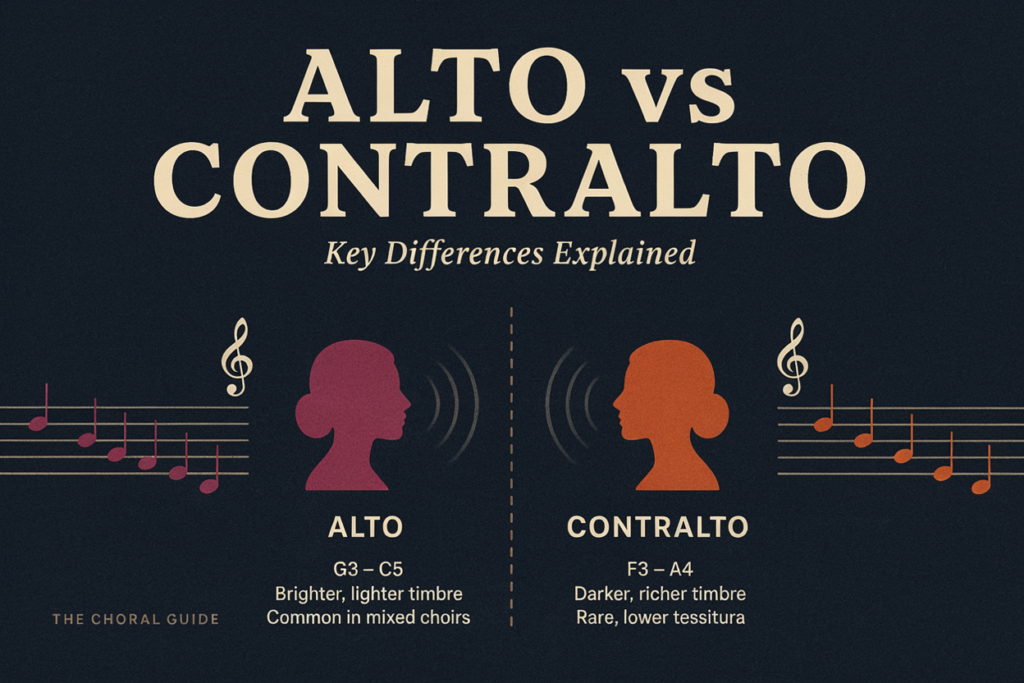
Alto and contralto are closely related terms used to describe lower
female voices, but they do not mean exactly the same thing. Alto usually
refers to a choir part or vocal section, while contralto is a specific
classical female voice type known for a naturally deep, rich, and dark
tone.
The confusion happens because many contraltos sing alto parts in choirs,
and many singers labeled as “alto” may actually be mezzo-sopranos or
lower sopranos. A singer’s true voice type depends on more than the
highest and lowest notes they can produce. Factors such as vocal color,
tessitura, vocal weight, and register behavior are also important.
Alto vs Contralto: What Are the Main Differences?
The biggest difference between alto and contralto is that alto is
generally a musical role, while contralto is a recognized voice
classification.
Feature Alto Contralto;
Meaning Usually a choir part A female classical
voice type
Main Use Choirs, ensembles, Opera and classical
arrangements singing
Range Often around F3–F5, Commonly around F3–F5,
depending on singer with stronger low
resonance
Tone Warm and lower than Dark, deep, and
soprano powerful
A singer can perform an alto part without being a true contralto. Choir
directors assign parts based on musical needs, while classical voice
classification focuses on the singer’s natural instrument.
What Is an Alto Voice?
An alto voice is the lower female vocal section in a choir or vocal
arrangement. In four-part harmony, the alto line usually sits below the
soprano and above the tenor or male lower parts.
The term “alto” originally described a vocal part rather than a specific
voice type. Today, singers with different natural voices, including some
mezzo-sopranos and contraltos, may sing alto parts.
Alto Vocal Characteristics
Alto singers often have:
- A comfortable middle-to-lower singing range
- A warm and balanced tone
- Strong chest voice development
- The ability to provide harmony support
Many alto singers have voices that are flexible and blend well with
other singers. The alto section is important because it adds depth and
harmonic color to a choir.
If you want to understand how different female voices are categorized,
the guide to female voice
types explains the
wider classification system.
What Is a Contralto Voice?
A contralto is a rare female voice type with a naturally low range and
distinctive dark vocal quality. Contraltos often have strong lower
notes, a rich chest register, and a unique resonance that separates them
from other female voices.
A true contralto is not simply a singer who can reach low notes. The
voice must also have the characteristic tone and comfortable singing
area associated with the classification.
Contralto Vocal Characteristics
Contraltos typically have:
- A deep, dark vocal color
- Strong low-register resonance
- Heavy vocal weight
- A comfortable tessitura in the lower female range
The contralto vocal range provides
more detail about typical notes and characteristics associated with this voice type.
Alto vs Contralto Range: Are They the Same?
Alto and contralto ranges can overlap, which is why many people confuse
them. Both may comfortably sing notes in the lower female register, but
the way those notes sound and feel is different.
A vocal range test can show the notes a person can produce, but it
cannot completely identify voice type. Two singers may have similar
ranges while having completely different vocal classifications because
their tone, resonance, and tessitura differ.
Understanding the difference between voice type and vocal
range helps explain why range alone is not enough.
Can an Alto Be a Contralto?
Yes, a contralto can sing alto parts, but not every alto singer is a
contralto.
In a choir, an alto section may include singers with different voice
backgrounds. A mezzo-soprano with a darker tone may sing alto, while a
true contralto may also perform the same part because of her naturally
lower instrument.
Classical singers usually determine voice type by examining:
- Comfortable singing range
- Vocal tone and resonance
- Register transitions
- Vocal strength across the range
A singer looking to understand their own classification can explore how
professionals approach finding voice
type.
How Can You Tell If You Are an Alto or Contralto?
The best way to distinguish between alto and contralto is to look beyond
your lowest note.
Check Your Comfortable Range
Your tessitura, the range where your voice feels most natural and
sustainable, is more useful than your extreme notes. A contralto usually
feels comfortable singing lower melodies without forcing the sound.
Listen to Your Vocal Color
Contralto voices often have a darker, fuller quality compared with many
alto singers. The sound may feel deeper and more resonant, especially in
the lower register.
Consider Professional Classification
Voice classification is complex. A trained vocal teacher usually
considers several factors rather than relying only on a vocal range
chart.
The female vocal range
chart can
help singers understand where different voice categories commonly sit.
Famous Contralto and Alto Singers
Some famous singers are often associated with lower female vocal
qualities. Classical contraltos include singers such as Kathleen Ferrier
and Marian Anderson, whose voices are known for depth and richness.
In popular music, many singers with lower female voices are sometimes
described as altos, although modern popular singing does not always
follow classical voice classifications.
A singer’s style, training, and repertoire can influence how their voice
is perceived. For example, a performer may have a low range but still
not fit the classical definition of contralto.
Why Are Contralto Voices Considered Rare?
Contralto voices are considered rare because relatively few female
singers naturally have the combination of low range, dark tone, and
vocal weight associated with the classification.
Many singers can develop stronger low notes through training, but
extending range does not necessarily change the natural voice type.
Voice type is connected to the physical characteristics of the vocal
instrument and how it functions.
For a broader look at uncommon voice categories, the discussion of rare
voice types explains
why some classifications are less frequently found.
Frequently Asked Questions
Is every alto singer a contralto?
No. Alto usually describes a choir part, while contralto is a specific
female classical voice type. Many altos are actually mezzo-sopranos or
other lower female voices.
Is contralto lower than alto?
A contralto is generally a lower female voice type, but alto is not
always a direct comparison because it usually refers to a singing part
rather than a biological voice classification.
Can a mezzo-soprano sing alto parts?
Yes. Many mezzo-sopranos sing alto in choirs because their range and
vocal color can fit the section.
How do I know if I have a contralto voice?
A true contralto is identified by more than low notes. Vocal tone,
comfortable range, resonance, and professional classification all help
determine whether a singer fits the category.

Benjamin Parker is a voice classification and singing analysis writer at VoiceTypeTest. He focuses on vocal type identification, vocal range analysis, pitch recognition, and singing education tools for vocalists, musicians, choir singers, and beginners.