
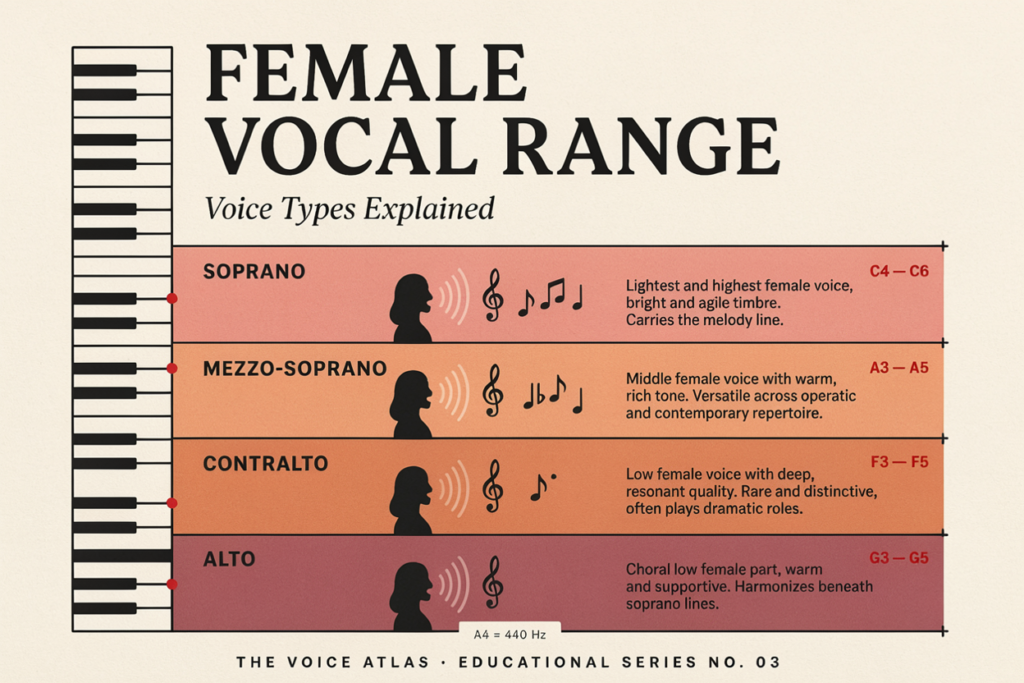
A female vocal range chart shows the typical note ranges of different
female voice types, including soprano, mezzo-soprano, alto, and
contralto. It helps singers understand where their voices may fit, but
vocal classification depends on more than range alone. Tessitura, tone
quality, vocal weight, and comfort are also important factors.
Female singers can have very different voices even when they share
similar highest and lowest notes. A singer who reaches a high note is
not automatically a soprano, because the area where the voice feels
strongest and most natural also matters.
What Is a Female Vocal Range Chart?
A female vocal range chart is a reference guide that displays the
approximate notes a female voice type can typically sing. It is commonly
used by singers, vocal teachers, and musicians to compare different
vocal categories.
The chart usually includes four main female voice classifications:
- Soprano
- Mezzo-soprano
- Alto
- Contralto
These classifications describe general vocal characteristics rather than
strict limits. Many trained singers can extend beyond these traditional
ranges.
Female Vocal Range Chart by Voice Type
Female Voice Type Typical Vocal Range Approximate Notes;
Soprano Highest female voice category C4–C6
Mezzo-soprano Middle female voice category A3–A5
Alto Lower female singing category F3–F5
Contralto Lowest female classical voice E3–E5
These ranges are approximate. Individual singers may have wider or
narrower ranges depending on anatomy, training, and vocal technique.
What Are the Different Female Voice Types?
Soprano Voice
The soprano is the highest standard female classical voice type.
Sopranos usually have bright, clear tones and strong upper registers.
Typical soprano characteristics include:
- High vocal range
- Bright vocal color
- Strong upper notes
- Ability to perform demanding melodic lines
Common soprano categories include coloratura soprano, lyric soprano,
spinto soprano, and dramatic soprano.
You can explore more about the typical notes of this category in the
guide to soprano range
notes.
Mezzo-Soprano Voice
A mezzo-soprano sits between soprano and contralto. This voice type
often has a warmer and richer tone compared with a soprano.
Mezzo-sopranos commonly have:
- Strong middle register
- Warm vocal quality
- Balanced high and low notes
Many singers find this voice type comfortable because it covers a wide
middle area.
Learn more about this classification through the explanation of
mezzo-soprano vocal
range.
Alto and Contralto Voice
Alto is often used to describe lower female singing parts, especially in
choirs. Contralto is a formal classical voice classification describing
a naturally low female voice.
Contraltos usually have:
- Deep vocal color
- Strong lower register
- Rich resonance
The difference between these categories is explained further in the
comparison of alto and contralto
voices.
Female Vocal Range Chart in Hz
Musical notes can also be measured by frequency in Hertz (Hz). Lower
notes have slower vocal vibrations, while higher notes have faster
vibrations.
Approximate examples:
Note Frequency;
E3 About 165 Hz
A3 About 220 Hz
C4 About 262 Hz
C5 About 523 Hz
C6 About 1047 Hz
Frequency can help measure pitch, but it does not fully determine voice
type. Two singers can produce similar frequencies but have different
vocal qualities.
How Does Female Vocal Range Compare to Male Vocal Range?
Female voices generally sit higher than male voices because vocal fold
size and structure influence fundamental frequency.
Male voice categories commonly include tenor, baritone, and bass, while
female categories usually include soprano, mezzo-soprano, alto, and
contralto.
A complete comparison requires looking at both range and vocal
characteristics. The relationship between these concepts is explained in
voice type and vocal range
differences.
How to Find Your Female Vocal Range
Finding your vocal range involves identifying your lowest and highest
comfortable notes.
Test Your Lowest Comfortable Note
Start with a comfortable pitch and gradually move downward. The lowest
note should be one you can produce clearly without forcing.
Test Your Highest Comfortable Note
Move upward gradually and identify the highest note you can sing with
control and a stable tone.
Identify Your Voice Type
After finding your range, consider:
- Where your voice sounds strongest
- Your natural tone color
- Your comfortable singing area
- Your tessitura
A range test alone cannot perfectly classify a voice. Understanding
what tessitura
means helps explain
why comfortable notes matter.
Vocal Range vs Voice Type: What Is the Difference?
Vocal range describes the complete span of notes a singer can produce.
Voice type describes the category that best matches a singer’s vocal
characteristics.
Concept Meaning;
Vocal range Lowest to highest notes a singer
can produce
Tessitura Notes where the voice feels most
comfortable
A singer may have a large range but still belong to a different voice
category because their strongest area determines their classification.
Can Female Vocal Range Increase?
Yes, many singers can expand their usable range through consistent
training and healthy technique.
Range development usually focuses on:
- Breath support
- Vocal coordination
- Resonance control
- Gradual practice
However, natural anatomy influences each singer’s ultimate range.
Expanding range should be done safely without forcing extreme notes.
Frequently Asked Questions
What is the average female vocal range?
Many female singers have a range of around two to three octaves,
although individual singers may have less or more depending on training
and natural ability.
What is the lowest female voice type?
Contralto is generally considered the lowest classical female voice
type. It is known for deep tone and strong lower resonance.
What is the highest female voice type?
Soprano is the highest standard female classical voice type. Some
sopranos can sing above typical soprano ranges through advanced
technique.
Is every woman who sings high a soprano?
No. High notes alone do not determine voice type. Tessitura, tone
quality, and vocal characteristics are also important.
How can I measure my female vocal range?
You can measure vocal range by finding your lowest and highest
comfortable notes. For accurate classification, consider range together
with voice type characteristics.

Benjamin Parker is a voice classification and singing analysis writer at VoiceTypeTest. He focuses on vocal type identification, vocal range analysis, pitch recognition, and singing education tools for vocalists, musicians, choir singers, and beginners.