
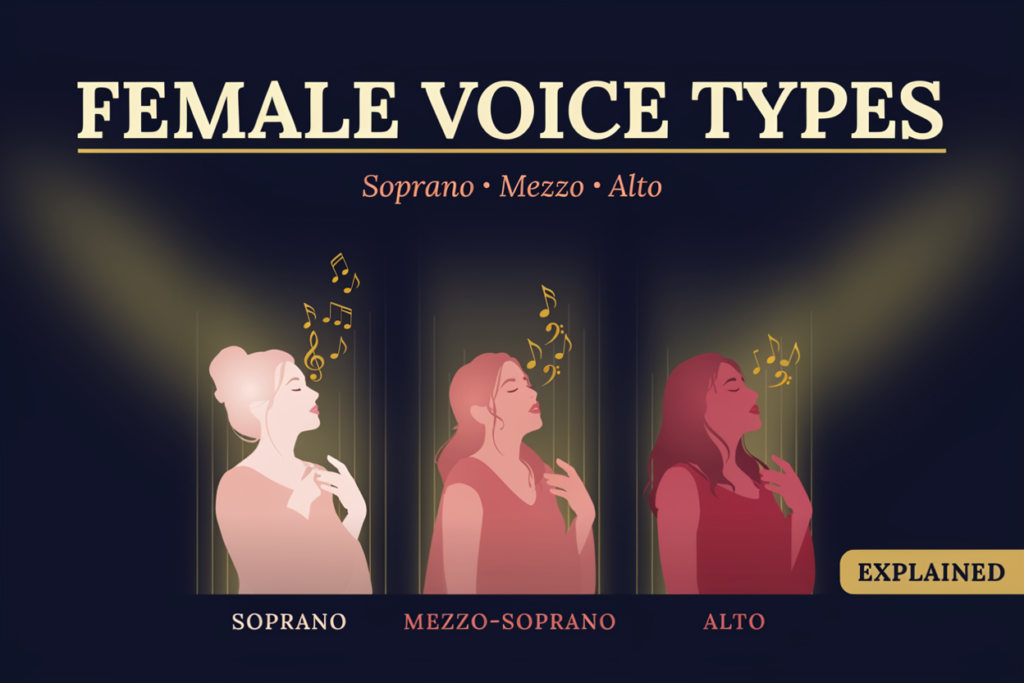
The main female voice types are soprano, mezzo-soprano, and contralto. Soprano is usually the highest common female voice type, mezzo-soprano sits in the middle, and contralto is the lowest female solo voice type. You may also hear the word alto, especially in choir, but alto is often a choral part rather than a strict solo voice type.
Female voice types are useful because they help singers choose songs, understand range, protect the voice, and find comfortable keys. But voice type should not be decided from one high note or one low note. A better classification looks at range, tessitura, tone, passaggio, vocal weight, and comfort.
Sing a few notes and discover your estimated voice type with our VoiceTypeTest.
What Are the Female Voice Types?
The three main female solo voice types are soprano, mezzo-soprano, and contralto. In choir, singers are often grouped into soprano and alto parts, but that does not always match their true solo voice type.
| Female Voice Type | General Position | Simple Description |
|---|---|---|
| Soprano | Highest | Bright, higher female voice |
| Mezzo-soprano | Middle | Warm middle female voice |
| Contralto | Lowest | Deepest common female solo voice |
| Alto | Choir part | Lower harmony role, not always a solo type |
The most important thing to remember is that voice type is not a ranking. A soprano is not better than a mezzo-soprano, and a contralto is not better because it is rarer. Each voice type has its own strengths.
Soprano Voice
A soprano is the highest common female voice type. Sopranos usually have easier access to higher notes and often sing bright melodies in choir, classical music, musical theater, and pop. Their voices may sound light, clear, ringing, dramatic, or agile depending on the singer.
Not every soprano sounds the same. Some sopranos have a light and flexible tone, while others have more power and weight. In pop music, a soprano may use breathy tone, head voice, mix, or microphone technique instead of classical projection.
If your voice feels most comfortable in higher melodies and lower harmony parts feel heavy or dull, you may lean soprano. The full guide to the soprano voice explains this category in more detail.
Mezzo-Soprano Voice
A mezzo-soprano is the middle female voice type. The word “mezzo” means middle, so this voice sits between soprano and contralto. Mezzo-sopranos often have a warm middle range, more depth than many sopranos, and more upper flexibility than many contraltos.
Many singers who feel “between soprano and alto” are mezzo-sopranos. They may be able to sing some soprano lines and some alto lines, depending on the song and key. In choir, a mezzo-soprano might sing Soprano II or Alto I based on the arrangement.
The guide to the mezzo-soprano voice gives a deeper explanation of this middle category, and the article on what is between soprano and alto is useful if you are unsure where your voice sits.
Contralto Voice
A contralto is the lowest female solo voice type. Contraltos usually have a naturally lower tessitura, darker tone, and comfortable low range. This voice type is less common than soprano or mezzo-soprano, but it should still be understood carefully.
A singer is not automatically contralto just because they can sing a few low notes. The low range needs to feel natural, usable, and repeatable. Tone, vocal weight, and comfort also matter. A mezzo-soprano can sometimes sing low notes, but a true contralto usually has a deeper natural center.
If you think your voice may be unusually low for a female singer, read the guide to contralto vocal range before choosing the label too quickly.
Alto Voice: Choir Part or Voice Type?
The word alto causes a lot of confusion. In many choirs, alto simply means the lower female harmony part. A singer may be assigned alto because the choir needs balance, because their middle range is strong, or because the arrangement fits their voice.
That does not always mean the singer is a contralto. Many altos in choir are actually mezzo-sopranos. Some may be contraltos, but not all. This is why it is better to separate choir placement from solo voice classification.
The alto voice guide explains how the term is commonly used, while alto vs contralto clears up the difference between a choir part and a lower female voice type.
Female Voice Type vs Vocal Range
Vocal range is the span from your lowest note to your highest note. Voice type is broader. It looks at where your voice feels most comfortable and how it behaves across songs.
The most important concept is tessitura. Tessitura means the part of your range where you can sing comfortably, clearly, and repeatedly. A singer may touch high soprano notes but feel tired singing there for a full song. Another singer may reach low notes but not sound strong or natural in that area.
That is why the article on what tessitura means is so helpful. It explains why your comfortable working range matters more than one impressive note.
How to Find Your Female Voice Type
To find your female voice type, do not rely on one song or one note. Use a simple process:
- Test your lowest and highest usable notes.
- Notice where your voice feels most comfortable.
- Pay attention to tone: bright, warm, dark, light, or weighty.
- Check whether high songs feel easy or tiring.
- Check whether low songs feel natural or forced.
- Compare your comfort zone with standard voice categories.
- Recheck over time as your voice develops.
A singing voice test can help you explore your practical range, while a voice analyzer can help you observe pitch behavior. If you want to check individual notes while singing, use a pitch detector.
For a complete step-by-step process, read the guide on how to find your voice type.
Common Mistakes About Female Voice Types
Avoid these common mistakes:
- Assuming your highest note automatically makes you soprano
- Assuming choir alto means you are contralto
- Ignoring tessitura and comfort
- Copying a celebrity singer’s key
- Forcing your voice lower to sound darker
- Forcing high notes to fit a soprano label
- Treating voice type as a ranking system
- Choosing a label before your voice is developed
A healthy voice type label should help you sing better. It should not make you strain, compare yourself unfairly, or avoid songs that fit your voice.
FAQ
What are the main female voice types?
The main female solo voice types are soprano, mezzo-soprano, and contralto. Alto is often used as a choir part.
What is the highest female voice type?
Soprano is usually the highest common female voice type.
What is the lowest female voice type?
Contralto is the lowest common female solo voice type.
Is alto a female voice type?
Alto is often a choir part. Some people use it casually as a voice type, but contralto is the more specific lower female solo category.
What is between soprano and alto?
Mezzo-soprano is between soprano and alto or contralto. It is the middle female voice type.
How do I know if I am soprano or mezzo-soprano?
You may be soprano if higher melodies feel natural and your upper range is strong. You may be mezzo-soprano if your middle range feels strongest and very high soprano lines feel tiring.
How do I know if I am alto or contralto?
If you sing alto in choir, you are not automatically contralto. Contralto requires a naturally lower tessitura, darker tone, and comfortable low range.
Is mezzo-soprano common?
Yes. Mezzo-soprano is a common female voice type and fits many singers who feel between soprano and alto.
Is contralto rare?
Yes, true contralto is generally considered less common than soprano or mezzo-soprano.
Can my female voice type change?
Your voice can develop with age, training, health, and technique. Your basic vocal structure may stay similar, but your usable range and comfort can improve over time.
Final Note
Female voice types are best understood as helpful guides, not strict boxes. Soprano is the highest common female voice type, mezzo-soprano is the middle voice, and contralto is the lowest female solo type. Alto is often a choir part, so it should not always be treated as the same thing as contralto.
To find your voice type, test your range, notice your tessitura, listen to your tone, and choose songs that feel comfortable. The best voice type label is the one that helps you sing more naturally and safely.

Benjamin Parker is a voice classification and singing analysis writer at VoiceTypeTest. He focuses on vocal type identification, vocal range analysis, pitch recognition, and singing education tools for vocalists, musicians, choir singers, and beginners.