
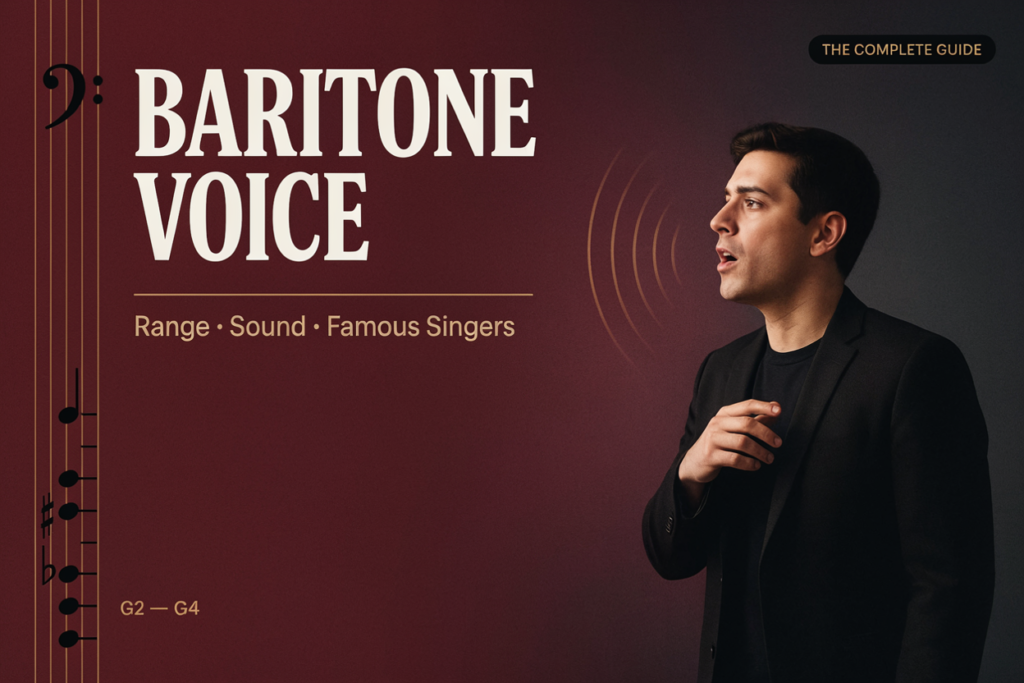
What Is a Baritone Voice?
A baritone voice is the middle male voice type, sitting between tenor and bass. Baritones usually have a warm, strong middle range, more depth than many tenors, and more upper flexibility than most basses. It is one of the most common male singing voice types, but that does not make it ordinary or less valuable.
A typical baritone range is often described around A2 to A4, though some systems may use slightly different ranges. The exact notes are only a starting point. To understand whether you are a baritone, you need to look at range, tessitura, tone, passaggio, vocal weight, and comfort.
You can identify your approximate singing voice type using our online Voice Type Test.
What Is a Baritone Voice?
A baritone is the middle male voice type. It is lower than tenor and higher than bass. Baritones often have a rich middle range that works well in pop, rock, musical theater, choir, classical music, worship, and many other styles.
| Male Voice Type | General Position | Simple Description |
|---|---|---|
| Tenor | Higher | Bright, higher male voice |
| Baritone | Middle | Warm, balanced male voice |
| Bass | Lower | Deep, low male voice |
The main idea is simple: if tenor songs often feel too high and bass songs feel too low, your voice may sit naturally in the baritone range.
Where Baritone Fits Among Male Voice Types
Male voices are commonly grouped into tenor, baritone, and bass. Tenor is the higher male category, bass is the lower male category, and baritone sits between them.
The guide to male voice types explains the larger system, while male voice classification goes deeper into how singers are grouped by range, tone, and vocal function.
Baritone is not a “middle” voice in a boring sense. It often has the best of both sides: enough depth for lower songs and enough flexibility for many higher melodies. This makes baritone a very practical and expressive voice type.
What Does a Baritone Voice Sound Like?
A baritone voice usually sounds warm, full, grounded, and balanced. Compared with many tenors, baritones often have more weight in the middle and lower-middle range. Compared with basses, baritones usually have more ease moving upward.
Common baritone qualities include:
- Strong middle range
- Warm tone
- Natural depth without extreme heaviness
- Flexible upper extension with training
- Clear speech-like storytelling quality
- Good fit for many popular music keys
Baritones often sound convincing in songs that need emotional directness, strength, and warmth. That is why many pop, rock, jazz, country, theater, and classical singers are described as baritones or baritone-like voices.
Baritone Vocal Range
A common baritone range is often listed around A2 to A4. Some baritone voices may extend lower or higher, especially with training. Others may have a slightly narrower practical range. That is normal.
The important word is usable. A note should be clear, repeatable, and healthy. If you can barely touch a low note once, it may not count as part of your true singing range. If you can shout a high note but cannot sing it comfortably, it may not define your voice type.
For more detail, read the guide to baritone vocal range. It explains how range works for baritones and why the middle of the voice matters so much.
Baritone vs Tenor
Tenor is higher than baritone, but the difference is not only about high notes. A trained baritone may be able to sing some tenor-range notes, especially in pop or musical theater. That does not automatically make him a tenor.
A tenor usually has a higher tessitura, meaning higher notes feel more natural over a whole song. A baritone may reach some of those notes, but they may feel more demanding or less sustainable.
| Feature | Tenor | Baritone |
|---|---|---|
| General position | Higher male voice | Middle male voice |
| Common tone | Bright, lifted, ringing | Warm, balanced, fuller |
| Comfort zone | Higher phrases | Middle-range phrases |
| Common confusion | Dark tenor mistaken for baritone | High baritone mistaken for tenor |
The guide on tenor vs baritone is useful if you are unsure which category fits you. You can also compare with the tenor vocal range page.
Baritone vs Bass
Bass is lower than baritone. A true bass usually has a naturally deep sound, strong low notes, and a low tessitura. A baritone may have some low notes, but the voice usually does not live as comfortably in the lowest male range.
This is another common mistake. A deep speaking voice does not always mean someone is a bass. Many men with deep or warm speaking voices are still baritones when they sing.
The bass vocal range guide explains the lower male category and can help you compare bass with baritone more clearly.
How to Know If You Are a Baritone
You may be a baritone if several of these feel true:
- Your middle range feels strongest
- Very high tenor songs feel tiring
- Very low bass songs feel forced or weak
- Your tone sounds warm or full
- Your voice feels comfortable in middle-low phrases
- You can sing some high notes, but they require more effort
- You do not feel naturally centered in the lowest bass range
A singing voice test can help you explore your usable range, while a pitch detector can help you identify the actual notes you are singing. A voice analyzer can also help you observe pitch behavior and consistency.
Range Is Not Enough: Tessitura and Comfort
Range alone does not decide voice type. A baritone may sing some tenor notes or reach some bass notes, but the key question is where the voice feels most comfortable.
This is where tessitura matters. Tessitura is the part of your range where your voice feels natural, clear, and repeatable. If your middle range feels stronger than your extreme high or low notes, that is a strong baritone clue.
The guide on voice type vs vocal range explains why range and voice type are not the same thing, and the article on what tessitura means explains the comfort-zone concept in more detail.
Famous Baritone Singers and Examples
Famous baritone singers can be useful examples, but remember that popular singers often use microphones, studio production, stylistic effects, and key changes. Their voice type is not always as simple as a classical label.
Still, listening to famous baritone singers can help you understand the warmth and flexibility often associated with the category. Some singers, like Freddie Mercury, are discussed often because they could sing high rock lines while still being commonly described as baritone or high baritone. The article on Freddie Mercury’s voice type explains why range alone can make classification confusing.
Common Mistakes About Baritone Voices
Avoid these mistakes:
- Thinking baritone is boring or less impressive
- Calling yourself tenor because you can sing one high note
- Calling yourself bass because you can sing one low note
- Forcing your voice darker to sound deeper
- Pushing high notes to prove you are not baritone
- Ignoring tessitura and comfort
- Copying celebrity singers in the wrong key
- Treating voice type as a ranking system
Baritone is a strong, flexible, expressive voice type. It can carry melody, harmony, drama, warmth, and power when used well.
FAQ
What is a baritone voice?
A baritone voice is the middle male voice type between tenor and bass. It usually has a warm tone and strong middle range.
Is baritone high or low?
Baritone is in the middle. It is lower than tenor but higher than bass.
Is baritone between tenor and bass?
Yes. Baritone sits between tenor and bass in the common male voice type system.
What is the range of a baritone voice?
A typical baritone range is often described around A2 to A4, but exact ranges vary by singer, system, and training.
Is baritone the most common male voice?
Baritone is often considered one of the most common male voice categories because many male voices sit naturally in the middle range.
Can baritones sing high notes?
Yes. Many baritones can sing high notes, especially with training. High notes alone do not automatically make someone a tenor.
How do I know if I am a baritone?
You may be a baritone if your middle range feels strongest, tenor songs feel too high, bass songs feel too low, and your tone is warm or balanced.
Is baritone lower than tenor?
Yes. Baritone is generally lower than tenor.
Is baritone higher than bass?
Yes. Baritone is generally higher than bass.
Can a baritone become a tenor?
A baritone can improve range and technique, but voice type usually depends on natural vocal structure, tessitura, tone, and comfort. Training can expand what you can sing, but it may not completely change your voice type.
Final Note
A baritone voice is the middle male voice type between tenor and bass. It is known for warmth, balance, strength, and a comfortable middle range. Baritone is not a weak or “average” label; it is one of the most useful and expressive male voice types.
To know if you are a baritone, test your usable range, notice your tessitura, and pay attention to where your voice feels clear and repeatable. The best voice type label is the one that helps you sing naturally, safely, and confidently.

Benjamin Parker is a voice classification and singing analysis writer at VoiceTypeTest. He focuses on vocal type identification, vocal range analysis, pitch recognition, and singing education tools for vocalists, musicians, choir singers, and beginners.