
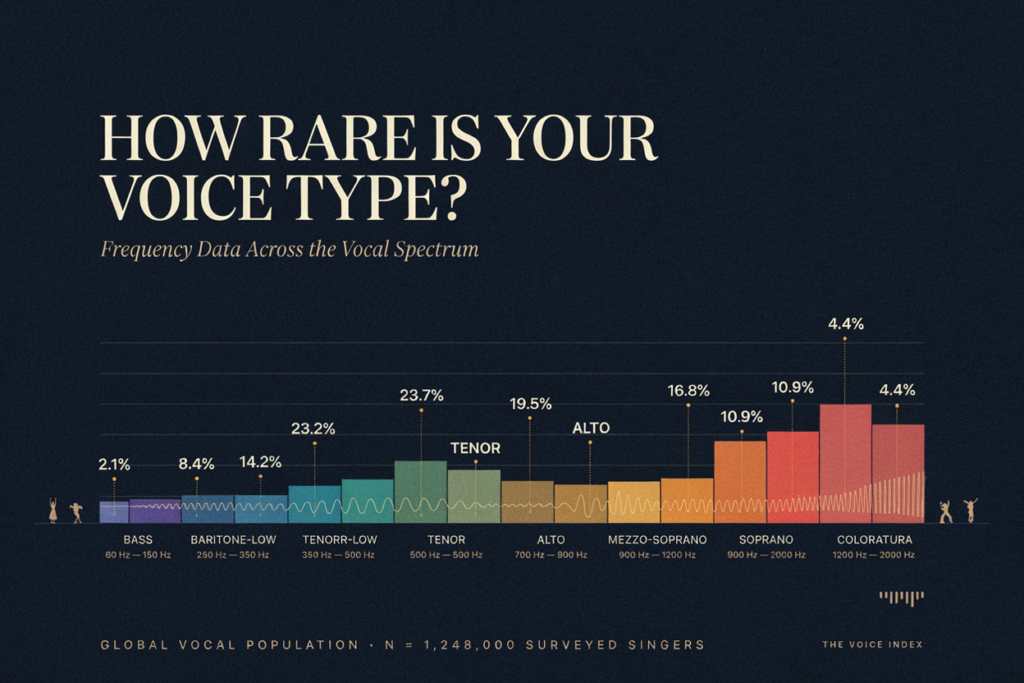
Your voice type can be considered rare when it has uncommon combinations
of vocal range, tone color, vocal weight, and comfortable singing range.
However, rarity is not determined by the highest or lowest note you can
sing alone. A voice type such as contralto or bass is considered
uncommon because fewer singers naturally have the required vocal
characteristics.
Classical voice classification looks at several factors, including
tessitura, which is the range where your voice sounds most natural,
vocal resonance, and the overall quality of your sound.
Which Voice Types Are the Rarest?
Voice type rarity is difficult to measure with exact percentages because
large population studies of classical voice categories are limited. Most
rarity discussions are based on professional singing classification
rather than the general population.
Voice Type Gender Rarity Level Why It Is Considered Rare;
Contralto Female Very rare Requires
naturally low
range, dark tone,
and strong lower
resonance
Bass Male Less common Requires
naturally deep
vocal weight and
low tessitura
Countertenor Male Uncommon Uses specialized
upper male vocal
technique
Mezzo-soprano Female Moderate Common classical
category with
many variations
Baritone Male Common Frequently found
male classical
classification
Soprano Female Common Widely
represented
female
classification
The rarest voice types are not always the voices with the widest range.
A singer may have an impressive range but still have a common voice
classification.
For a deeper look at uncommon classifications, the guide about rare
voice types explains
why certain categories appear less frequently.
Why Are Some Voice Types Rarer Than Others?
Several factors influence why some voices are less common.
Vocal Anatomy and Range
Every singer has a unique vocal instrument. The size and structure of
the vocal folds, resonance spaces, and overall vocal system influence
how a voice develops.
Lower voice types often require specific combinations of vocal depth and
resonance. For example, a true contralto is not simply someone who can
sing low notes. The voice must also have the characteristic tone and
comfort associated with the classification.
Tessitura and Vocal Comfort
Tessitura is one of the most important factors in voice classification.
It describes the area where a singer can perform comfortably for an
extended time.
A singer may reach a low note once, but that does not necessarily mean
they have a low voice type. A rare voice classification depends on where
the voice naturally feels strongest and most sustainable.
Training and Classification Systems
Voice rarity also depends on the classification system being used.
Classical opera uses detailed categories based on vocal characteristics,
while modern music often uses broader descriptions.
A singer classified as an alto in a choir may not necessarily be a
contralto in classical terms. Understanding female voice
types and male
voice types helps
explain these differences.
Is a Wide Vocal Range the Same as a Rare Voice Type?
A wide vocal range and a rare voice type are different things.
A singer with a four-octave range may have exceptional technical
ability, but their natural voice classification could still be soprano,
tenor, baritone, or another common category.
Voice type depends on:
- Comfortable singing area
- Vocal tone
- Resonance
- Vocal weight
- Register behavior
A vocal range test can estimate your available notes, but it cannot
completely determine how rare your voice type is.
The difference between these concepts is explained further in the
article about voice type and vocal range.
How Can You Find Out How Rare Your Voice Type Is?
To understand whether your voice type is uncommon, you first need to
identify your classification.
Check Your Vocal Range
Your range gives useful information about the notes you can produce.
However, it is only one part of classification.
Evaluate Your Vocal Characteristics
Listen for your natural tone, resonance, and the areas where your voice
feels strongest. These characteristics often reveal more than extreme
notes.
Compare With Established Voice Types
Understanding common categories such as soprano, mezzo-soprano,
contralto, tenor, baritone, and bass helps you identify where your voice
fits.
A professional vocal assessment can provide a more complete
classification because trained teachers consider multiple
characteristics together. You can also learn more about the process
through how to find your voice
type.
Rare Female Voice Types
Among female classical voices, contralto is often considered one of the
rarest categories.
A true contralto typically has:
- A naturally deep vocal range
- Dark vocal color
- Strong lower resonance
- Comfortable low-register singing
Many singers with lower voices are classified as altos or mezzo-sopranos
rather than true contraltos.
The contralto vocal
range guide
explains the characteristics that separate this voice type from other
lower female classifications.
Rare Male Voice Types
Among male voices, bass classifications are considered less common
because naturally deep voices are not as frequently found.
Bass singers typically have:
- Strong low notes
- Deep resonance
- Heavy vocal quality
- Comfortable lower tessitura
Some specialized categories, such as countertenor, are also uncommon
because they rely on specific vocal techniques and range development.
The bass vocal range
article explores the characteristics of this low male voice category.
Famous Singers With Rare Voice Types
Throughout music history, some singers have become recognized for
unusual vocal characteristics.
Famous contraltos such as Marian Anderson demonstrated the depth and
richness associated with rare lower female voices. Classical bass
singers such as Feodor Chaliapin showed the power and resonance possible
in deep male voices.
However, a famous singer’s popularity does not automatically mean their
voice type is rare. Rarity comes from the combination of natural vocal
characteristics and classification.
Frequently Asked Questions
What is the rarest female voice type?
Contralto is often considered the rarest female classical voice type. It
requires a naturally low range, dark tone, and strong lower-register
resonance.
What is the rarest male voice type?
Bass voices are considered less common among male classical singers,
while countertenors are also uncommon because they require specialized
upper-register ability.
Is having a four-octave vocal range rare?
A four-octave range is uncommon, but range alone does not determine
voice type rarity. Vocal classification depends on tone, tessitura, and
vocal characteristics.
Can your voice type change?
Your natural voice type usually remains stable, but training can improve
range, flexibility, and vocal control. A singer’s classification may
become clearer as their technique develops.

Benjamin Parker is a voice classification and singing analysis writer at VoiceTypeTest. He focuses on vocal type identification, vocal range analysis, pitch recognition, and singing education tools for vocalists, musicians, choir singers, and beginners.