
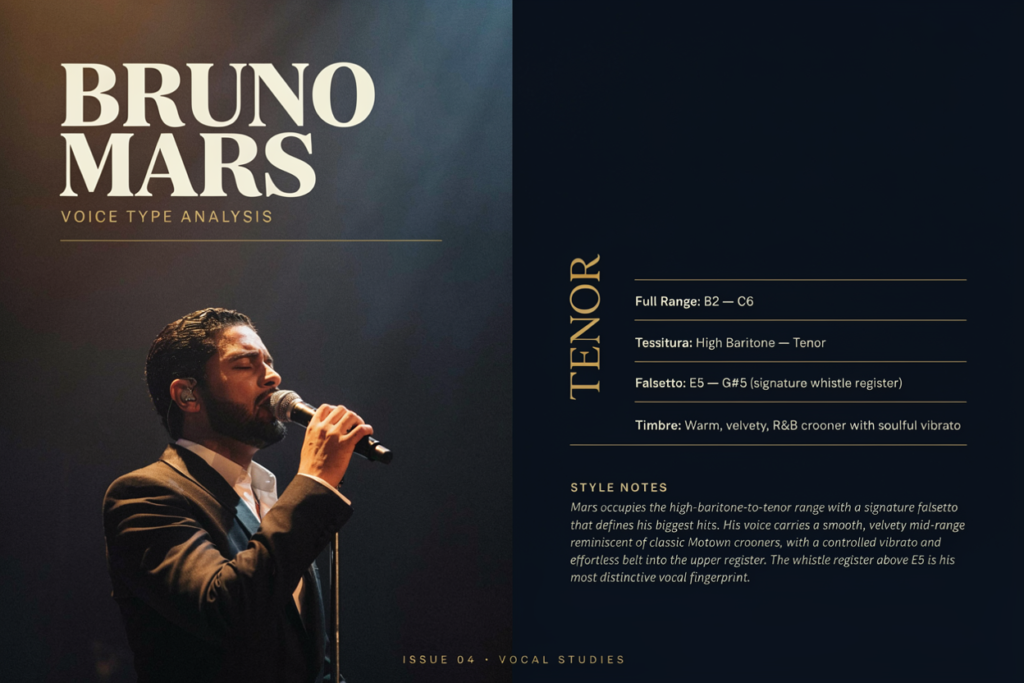
Bruno Mars is most often described as a tenor, especially a light lyric tenor-style pop/R&B singer. His voice is known for a bright upper range, strong falsetto, agile phrasing, rhythmic precision, and smooth movement between pop, funk, soul, and R&B styles.
The safest way to describe him is a high, bright pop tenor with strong falsetto and flexible mix control. However, his voice type should not be judged by high notes alone. A singer’s classification depends on range, tessitura, passaggio, tone, vocal weight, and where the voice feels most natural.
Want to know your singing voice type? Try our Voice Type Test.
What Voice Type Is Bruno Mars?
Bruno Mars is best understood as a tenor or light lyric tenor-style pop/R&B vocalist. His bright tone, high-centered singing, strong falsetto, and agile phrasing make tenor the most useful practical label.
| Vocal Factor | What It Suggests |
|---|---|
| Bright upper range | Tenor-leaning quality |
| Strong falsetto | Upper extension and pop style |
| Agile phrasing | R&B and soul flexibility |
| Lighter vocal weight | Light lyric tenor-like color |
| Rhythmic delivery | Pop/funk performance identity |
The key point is that Bruno’s voice is not only high. It is also rhythmically sharp, flexible, and performance-ready.
Why Bruno Mars Is Usually Called a Tenor
Bruno Mars is usually called a tenor because his voice sits comfortably in a higher male pop range. Tenors typically have easier access to higher notes than baritones and often carry a brighter vocal color. Bruno’s tone is light, energetic, and lifted, especially in songs that require high choruses, quick phrasing, and soulful vocal movement.
A tenor voice does not always sound classical or operatic. In pop and R&B, a tenor may use falsetto, mix, microphone technique, bright vowels, and rhythmic phrasing instead of traditional classical projection. Bruno’s voice fits that modern pop tenor profile well.
For broader context, the guide to male voice classification explains how tenor, baritone, and bass voices differ, while the page on tenor vocal range gives more detail on the highest common male voice category.
Vocal Range vs Voice Type
Bruno Mars is often discussed for his high notes, but vocal range is not the same as voice type. Vocal range means the full span from a singer’s lowest usable note to highest usable note. Voice type is more about where the voice sounds comfortable, balanced, and repeatable.
That comfortable area is called tessitura. A singer may reach a high note for one chorus or use falsetto for a special effect, but those notes do not always reveal the natural center of the voice. The guide on voice type vs vocal range explains this difference clearly, and the article on what tessitura means helps show why comfort matters more than one impressive note.
Bruno’s tessitura often supports the tenor label because much of his music sits in a bright, high-energy male pop range.
Is Bruno Mars a Baritone?
Some listeners may wonder if Bruno Mars is a baritone because he can sing with fuller tone in certain lower or middle phrases. But a few lower notes do not make a singer a baritone. Baritone voices usually have more weight, depth, and natural center in the middle-lower male range.
Bruno’s overall vocal identity is lighter, brighter, and more upper-centered than a typical baritone. His high pop choruses, falsetto moments, and agile R&B phrasing all point more clearly toward tenor. To understand the difference, compare the guide on baritone vocal range with the direct explanation of tenor vs baritone.
A careful conclusion is that Bruno is not best described as a baritone. He is better understood as a pop/R&B tenor with strong upper-register control.
Falsetto, Mix, and High Notes
Falsetto is one of Bruno Mars’ most recognizable vocal tools. He often uses it for smooth, soulful, and playful high phrases. Falsetto can make a male voice sound much higher, but it does not determine voice type by itself.
A singer’s full classification depends on the whole voice, not only falsetto notes. Bruno’s tenor label is supported not just by falsetto, but by his bright tone, high tessitura, flexible mix, and light vocal weight.
His mixed voice also matters. Mix helps a singer connect chest voice and head voice so higher notes can sound fuller than falsetto but less pushed than pure chest voice. Bruno’s high pop lines often rely on this kind of coordination.
If you are practicing high notes, use a pitch detector to observe pitch, not to force your voice upward. A vocal pitch monitor can also help you track notes while staying aware of comfort.
What Makes Bruno Mars’ Voice Unique?
Bruno Mars’ voice is unique because it combines high male pop range with rhythm, groove, and performance energy. He is not only a high singer. He is a highly musical singer.
| Vocal Trait | Why It Matters |
|---|---|
| Falsetto | Adds smooth upper-register color |
| Bright tone | Gives choruses energy and lift |
| R&B phrasing | Makes lines flexible and expressive |
| Rhythmic precision | Keeps vocals locked into the groove |
| Mix control | Helps high notes sound connected |
| Live stamina | Supports energetic stage performance |
| Retro soul influence | Gives his sound warmth and character |
His best performances often feel effortless because the rhythm, vocal tone, and stage energy work together.
Bruno Mars Compared With Other Singers
Bruno Mars is often compared with other high male pop and rock singers, but his vocal identity is distinct.
Compared with Freddie Mercury’s voice type, Bruno has a lighter, brighter pop/R&B tenor sound. Freddie is often discussed as a baritone or high baritone with tenor-range extension, while Bruno fits more naturally into the tenor category.
Compared with a typical tenor, Bruno has the high range, lightness, and brightness expected from the category, but his style is shaped strongly by funk, soul, and R&B phrasing. Compared with a typical baritone, his voice is less weighty and more upper-centered.
This is why Bruno’s voice type should be understood through both classification and style. His tenor quality matters, but so do rhythm, groove, and stage performance.
Can You Sing Like Bruno Mars?
You can study Bruno Mars’ pitch accuracy, rhythm, falsetto control, phrasing, dynamics, and stage confidence. But you should not force his high notes or try to imitate falsetto by squeezing the throat. High pop singing should feel coordinated, not strained.
A safer approach is to understand your own voice first. Use a singing voice test to explore your comfortable range. A voice analyzer can help you observe pitch behavior and vocal patterns while you practice.
The goal is not to sound exactly like Bruno. The better goal is to learn from his timing, control, and vocal energy while building a healthy version of your own sound.
Common Mistakes When Analyzing Bruno Mars’ Voice
Avoid these mistakes:
- Assuming falsetto alone defines voice type
- Judging his voice from one high note
- Confusing vocal range with tessitura
- Ignoring rhythmic phrasing and genre style
- Assuming every high male singer sings the same way
- Calling him baritone because of a few fuller lower notes
- Forcing high notes without proper coordination
- Treating voice type as a ranking system
A better analysis looks at the whole voice: range, tone, comfort, tessitura, vocal weight, falsetto, mix, rhythm, and style.
FAQ
What voice type is Bruno Mars?
Bruno Mars is most often described as a tenor, especially a light lyric tenor-style pop/R&B vocalist.
Is Bruno Mars a tenor?
Yes. Tenor is the safest practical label because his voice is bright, high-centered, agile, and comfortable in upper male pop ranges.
Is Bruno Mars a light lyric tenor?
Light lyric tenor is a useful descriptive label for his lighter vocal weight, bright tone, and flexible upper range, though it should be understood in a pop/R&B context.
Is Bruno Mars a baritone?
Bruno Mars is not usually classified as a baritone. His overall vocal identity is brighter, lighter, and more upper-centered than a typical baritone.
What is Bruno Mars’ vocal range?
His exact range varies by source and performance. For classification, tessitura, tone, comfort, and vocal weight matter more than one highest or lowest note.
Does Bruno Mars use falsetto?
Yes. Falsetto is a major part of his sound, especially in smooth pop, soul, and R&B-style phrases.
Why does Bruno Mars sing so high?
His voice is naturally tenor-leaning, and he uses mix, falsetto, bright resonance, and strong technique to handle high pop melodies.
Is vocal range the same as voice type?
No. Range is the span of notes a singer can produce. Voice type also depends on tessitura, passaggio, tone, vocal weight, and comfort.
Can I sing like Bruno Mars?
You can study his rhythm, falsetto, phrasing, and pitch control, but do not force high notes. Build range and coordination gradually.
How can I find my own male voice type?
Test your range, notice your tessitura, compare your comfortable notes with male voice categories, and avoid judging your type from one extreme note.

Benjamin Parker is a voice classification and singing analysis writer at VoiceTypeTest. He focuses on vocal type identification, vocal range analysis, pitch recognition, and singing education tools for vocalists, musicians, choir singers, and beginners.