
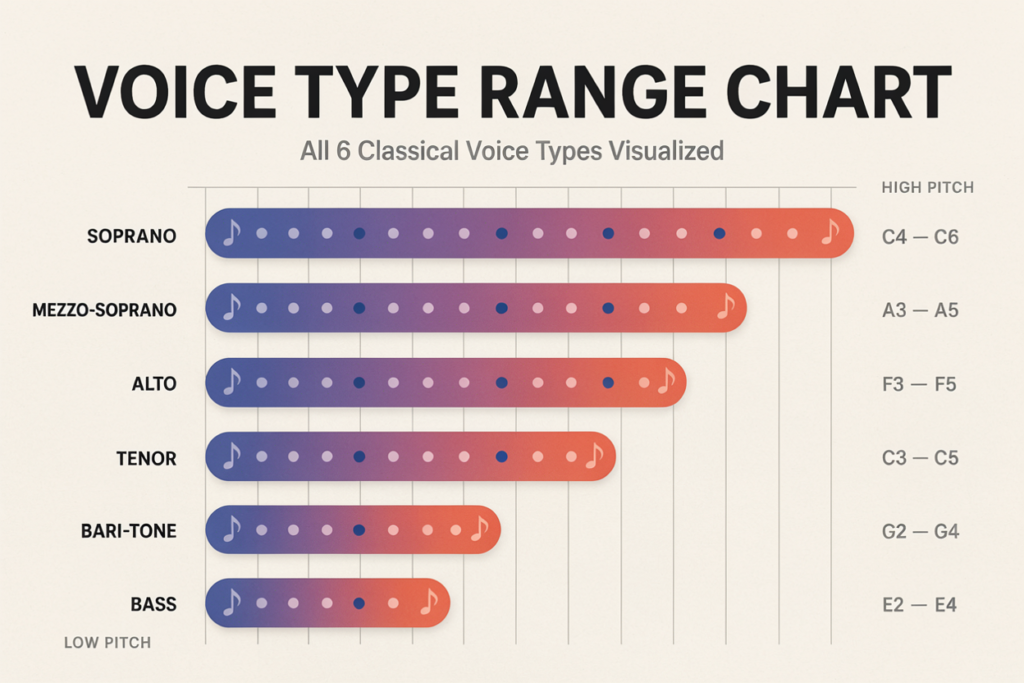
A voice type range chart displays the lowest and highest notes that each vocal classification can typically produce, measured from bass (the lowest voices) to soprano (the highest). These charts use musical note names like C, D, E, and so on, combined with octave numbers—so “C4” is middle C on a piano, and “C5” is one octave higher. Voice type range charts matter because they give singers a visual reference point for where their natural voice sits and help choir directors, vocal coaches, and learners understand how different voice types fit together harmonically.
How to Read the Chart
Reading a range chart takes a few seconds once you know what you’re looking at. Each voice type occupies a horizontal band or line spanning from its lowest note (on the left) to its highest note (on the right). The notes move left to right in ascending pitch—so if you see a voice type’s line starting at E2 and ending at E4, that means a singer with that classification can comfortably access notes from E2 (very low) all the way to E4 (higher, but still within the natural voice). Many charts also show “comfortable range” as a narrower band within the full range, because most singers live in a zone where their voice feels easiest and most resonant—this zone is called your tessitura.
Note Names vs. Frequencies
You’ll see voice type ranges written two ways: by note name (C3, A4, F5) or by frequency in Hertz (Hz). A note name tells you which note it is; frequency tells you how fast the vocal folds vibrate to produce that note. For example, C4 (middle C) vibrates at about 262 Hz, while C5 (one octave higher) vibrates at about 523 Hz. Musicians typically think in note names; scientists, engineers, and audio folks think in Hz. A complete chart gives both, so everyone can find what they need.
Male Voice Types and Their Ranges
Male voices traditionally divide into three categories: tenor (high), baritone (middle), and bass (low). These distinctions are based on comfortable singing range and the specific resonant qualities of each voice type—not just where the absolute highest and lowest notes sit.
Tenor
A tenor’s range typically spans from C3 (two octaves below middle C) to C5 (one octave above middle C). In Hz, that’s roughly 131 Hz at the low end to 523 Hz at the high end. Tenors are the highest male voice type and often carry the melody line in choral music. If you find yourself naturally singing the highest male line in a group without straining, or if you identify with singers like Pavarotti or Bruno Mars in terms of pitch comfort, you’re likely a tenor. The tenor range overlaps with baritone at the lower end, so some singers with a flexible voice might sing either part depending on the arrangement. When you explore the specifics of tenor classification, you’ll discover why this overlap matters and how to determine if you’re a high baritone or a low tenor.
Baritone
Baritones sit in the middle of the male vocal range, typically from A2 (about 110 Hz) to F4 (about 349 Hz). Baritones are the most common male voice type, and they’re often assigned the harmonic line that sits comfortably between the tenor melody and the bass foundation. If you find yourself too high for bass parts but too low for tenor parts, baritone is likely your home. Understanding baritone range in depth helps you see where your voice sits relative to adjacent types and why many well-known male singers occupy this space naturally.
Bass
The bass voice is the lowest male classification, usually ranging from E2 (about 82 Hz) to E4 (about 330 Hz). Bass singers provide the acoustic foundation of a choir or ensemble; their low notes anchor the harmonic structure and add weight and depth to the overall sound. Not all men can comfortably sing bass—it requires vocal anatomy that naturally produces lower resonant frequencies. If you’re consistently placed in the lowest section of a choir and feel at home there, you’re probably a bass. Diving deeper into bass range shows you how this classification produces its characteristic resonant tone.
Female Voice Types and Their Ranges
Female voices traditionally divide into three categories as well: soprano (high), mezzo-soprano (middle), and alto (low). Some sources distinguish between alto and contralto as separate types, though in modern practice they often overlap.
Soprano
The soprano range typically spans from C4 (middle C, about 262 Hz) to C6 (two octaves above middle C, about 1047 Hz). Sopranos are the highest female voice type and are often featured singing the main melody in choral, operatic, and ensemble settings. If you’re regularly placed on the top line of a choir part and feel at home there, you’re likely a soprano. Operatic sopranos can push even higher into the stratosphere; popular and musical theatre sopranos may sit slightly lower but still claim the soprano classification based on their resonant comfort zone. Checking soprano range details gives you the specific note breakdowns and what makes a soprano distinctly high.
Mezzo-Soprano
Mezzo-soprano—Italian for “half-soprano”—occupies the middle-to-high range for female voices, typically from A3 (about 220 Hz) to A5 (about 880 Hz). Mezzo-sopranos are extremely common; many female singers naturally fall into this zone. The mezzo range overlaps significantly with both soprano and alto, so a mezzo can often sing multiple parts depending on the arrangement and their own flexibility. Many famous female singers in pop and R&B are mezzo-sopranos, even if they don’t use that classical terminology. Learning more about mezzo-soprano classification helps you understand why this is the most flexible of female voice types.
Alto and Contralto
The alto range typically runs from G3 (about 196 Hz) to E5 (about 659 Hz). Contralto, the lowest female voice type, usually spans from F3 (about 175 Hz) to F5 (about 698 Hz). The distinction between alto and contralto is subtle and often depends on the resonant quality and comfort zone of the singer rather than a hard range boundary. Many singers and choir directors use “alto” as a catch-all for lower female voices. True contraltos are less common than sopranos or mezzo-sopranos, making contralto one of the rarer voice types.
Understanding Range vs. Tessitura
A voice type range chart shows the full span of notes a voice can reach—the absolute highest and lowest—but that’s not the whole story. Your tessitura is the range where your voice sounds most comfortable, most powerful, and most resonant. You might be able to sing a high note or a low note for a moment, but your tessitura is where you’d want to live during a long song or performance.
Why Range Isn’t Everything
Two singers might have nearly identical full ranges (for example, both spanning C3 to C5) but have completely different tessituras. One might feel most at home between F3 and F4, while the other shines between G3 and G4. This difference matters when assigning choir parts, choosing repertoire, or understanding where your voice naturally excels. A chart that shows only range without tessitura can be misleading, which is why many modern voice training resources highlight both. Understanding tessitura more deeply explains why this concept matters even more than raw range.
Finding Your Comfort Zone
To find your tessitura, pay attention during singing where you feel the least fatigue, where your tone sounds fullest, and where you can access dynamic control (singing loudly and softly) most easily. This zone usually comprises about an octave or so of your full range. If a chart or test tells you you’re a soprano but you feel most comfortable in the upper-middle soprano range, that’s normal—you’re a soprano with a tessitura in the upper part of that category. Tessitura is personal and can also improve with training over time.
How to Use a Range Chart to Find Your Voice Type
If you’re new to thinking about voice types, a range chart can be a useful reference point, though it’s never a substitute for working with a vocal coach or experienced musician who can hear you sing.
Start by finding your lowest and highest note comfortably—and the operative word is comfortably. Don’t strain to squeeze out a note; just gently explore where your voice naturally sits at the extremes. A vocal range test (whether online or with a teacher) can help you identify these boundary notes. Once you have those two points, compare them to the chart. Most people find they align reasonably well with one of the six main voice types, though some singers land between categories, which is perfectly normal.
Remember that a chart shows typical ranges, not absolutes. Individual variation is real—some sopranos have a lower ceiling than others, some tenors are surprisingly deep. After you narrow down to a range on the chart, consider which voice type feels most resonant and sustainable over time. That’s likely your voice type, and when you find out more about your specific classification, you can get even more specific guidance.
Voice Type Range Chart Reference Table
Below is a comprehensive reference table showing all six main voice types with their typical note ranges, approximate frequency ranges in Hz, and their relative position in the pitch spectrum. Use this as a quick lookup when you’re trying to place yourself or understand where a voice type sits relative to others.
| Voice Type | Lowest Note | Highest Note | Low Frequency (Hz) | High Frequency (Hz) | Classification |
|---|---|---|---|---|---|
| Bass | E2 | E4 | 82 | 330 | Lowest male voice |
| Baritone | A2 | F4 | 110 | 349 | Middle male voice |
| Tenor | C3 | C5 | 131 | 523 | Highest male voice |
| Contralto | F3 | F5 | 175 | 698 | Lowest female voice (rare) |
| Alto | G3 | E5 | 196 | 659 | Lower female voice |
| Mezzo-Soprano | A3 | A5 | 220 | 880 | Middle-high female voice |
| Soprano | C4 | C6 | 262 | 1047 | Highest female voice |
Notice that adjacent voice types overlap in their ranges—a high baritone can hit notes in the low tenor range, and a low soprano can reach notes at the high end of the mezzo-soprano range. This overlap is one reason why range alone doesn’t determine voice type; tessitura and tonal quality matter equally.
How Ranges Overlap and Why That’s Normal
Many singers wonder why their range seems to fit multiple voice types. This happens because vocal anatomy varies widely. You might have the low end of a bass but the high end of a baritone—you’re still one voice type, just one with a wider-than-average span. Alternatively, your resonance and comfort might place you squarely in baritone, even if you can technically hit a few tenor notes on a good day.
When you explore the deeper details of your specific voice type, you’ll understand not just the range boundaries but also the characteristic tone quality that defines that classification. Tenors, for example, are known for a bright, penetrating quality; basses are known for a rich, resonant depth. These qualities matter more than pure note range when a vocal coach or choir director is assigning your part.
Ranges in Different Musical Genres
It’s worth noting that “standard” voice type ranges come largely from classical and operatic tradition. In pop, R&B, gospel, and musical theatre, singers often work within a narrower practical range—a pop soprano might stay between D4 and A5 for most of a song, even though a classical soprano might command C4 to C6. The chart remains useful as a reference, but real-world singing, especially in non-classical genres, often focuses on a smaller portion of the full range. When you’re looking at famous singers in your voice type category, you’ll notice many stay comfortably in a smaller zone most of the time.
FAQ
What’s the difference between my vocal range and my voice type? Your vocal range is the span of notes you can produce from lowest to highest. Your voice type is a classification based on where your range sits and the characteristic resonant qualities of your voice. You might be a soprano with a range of C4 to C6, but another soprano might range from B3 to B5—both are sopranos despite slightly different ranges.
Do all singers of the same voice type have identical ranges? No. While voice type classifications group singers by approximate pitch zone and tonal quality, individual variation is normal. A tenor’s range might be C3 to C5, but another tenor might range from B2 to B4. The classification describes where you sit acoustically and where your voice feels most natural, not an exact, universal range.
Can my range change over time? Yes, especially with training. A vocal coach can help you extend both your upper and lower range safely over months or years of practice. Your voice type—the zone where you naturally resonate—tends to stay the same, but you can often find additional range on either end through proper technique.
What if my range doesn’t fit neatly into one voice type? Many singers have a range that spans parts of two adjacent types. A mezzo-soprano might have the low end of a mezzo and the high end of a soprano. In that case, think about your tessitura and your tonal comfort—where does your voice live most naturally? That’s your voice type, even if you can technically hit notes a bit higher or lower.
How accurate are online voice type tests? Online vocal range tests are useful for getting a rough estimate, but they’re not medical measurements. They’re estimates based on the notes you can produce, usually by having you sing sirens or scales and clicking buttons to mark your boundaries. A trained ear—whether a vocal coach or an experienced choir director—is more reliable than a tool, because they can assess not just range but also tone quality and tessitura.
Can I be a soprano if I don’t have an extremely high range? Yes. Sopranos are the highest female voice type, but “highest” is relative. A soprano’s range might start at C4, but some sopranos are more comfortable in the middle and upper-middle of that range rather than pushing toward the stratosphere. Your voice type is determined by your natural resonance and comfort zone, not by whether you can hit the absolute highest note in your category.

Benjamin Parker is a voice classification and singing analysis writer at VoiceTypeTest. He focuses on vocal type identification, vocal range analysis, pitch recognition, and singing education tools for vocalists, musicians, choir singers, and beginners.