
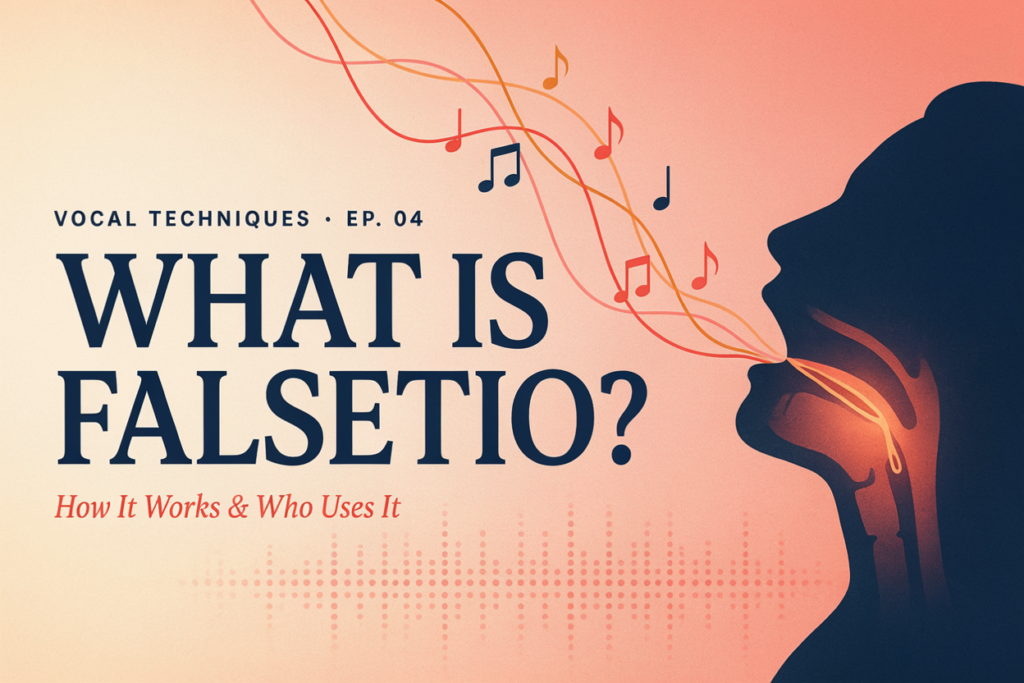
Falsetto is a singing technique where male singers produce notes above their natural range by reducing vocal fold contact and using lighter phonation, creating a thinner, airier tone. Unlike head voice—which is a register or resonance zone—falsetto is a specific way of engaging the vocal folds to access higher pitches. Falsetto is not a voice type; it’s a tool, a technique that sits above your normal singing voice and extends your range upward artificially.
How Falsetto Works Physiologically
When you sing in your natural chest voice or even head voice, your vocal folds vibrate together with meaningful contact, producing a full, resonant tone. In falsetto, you reduce that contact significantly. Your folds vibrate more loosely and vibratorily, almost like they’re grazing each other rather than engaging fully. This lighter engagement produces higher frequencies but sacrifices the warmth and power you get from full vocal fold contact. The result is a breathy, ethereal sound—the signature falsetto quality.
Falsetto is safe when produced correctly, though it requires relaxation and proper breathing. Straining in falsetto—trying to force it louder or hold it longer than comfortable—can cause tension. The key is ease and lightness, not effort.
If you’re unsure of your voice classification, take our voice type test to get started.
Falsetto vs. Natural Range
Your natural range is the zone where your voice sits comfortably using normal vocal fold engagement. For a baritone, that’s roughly A2 to F4. Above F4, a baritone can’t access higher notes using full voice—so falsetto becomes an option. A baritone singing in falsetto might reach up to A4, B4, or even higher. But the sound is thin and breathy, not the rich tone of their natural range.
This is different from a tenor, whose natural range (C3–C5) already extends higher. A tenor might not need falsetto as often because their natural range already reaches where a baritone needs to use technique.
Falsetto, Head Voice, and Chest Voice: The Differences
Understanding how these three registers relate—and differ—is crucial for singers.
Chest Voice
Chest voice is your normal singing voice, the one you use for everyday speech and comfortable singing. Vibrations resonate in your chest; vocal folds engage fully. Tone is warm, powerful, and grounded. For a bass, that might be E2–E4. For a soprano, C4–C5. Chest voice is where most singers live most of the time.
Head Voice
Head voice is a register where vibrations resonate in your head and sinuses, producing a lighter, more ethereal tone than chest voice but with more body and control than falsetto. Your vocal folds still engage, just more lightly. Male singers can access head voice, though it’s more commonly discussed with female singers. When you understand chest voice vs head voice, you learn that head voice is a legitimate, powerful tool—not a “fake” voice.
Falsetto
Falsetto is a technique, not a register. Your vocal folds barely engage; the tone is thin and breathy. Falsetto is above your natural range and above your head voice. It’s a way to reach very high notes when your natural voice can’t. Male singers use falsetto; female singers access very high notes through head voice or whistle tone, not falsetto (though the terminology sometimes gets confused).
Why Singers Use Falsetto
Falsetto appears across many genres. Soul and R&B singers like Michael Jackson and D’Angelo use falsetto as an expressive tool, sometimes singing entire phrases in falsetto for emotional effect. Pop singers like Justin Timberlake and Prince employ falsetto to access higher melodies or create distinctive vocal color. Musical theatre singers use falsetto occasionally to reach notes written above their natural range. Gospel singers layer falsetto harmonies to create rich, layered textures.
Falsetto isn’t limited to any one voice type—any male singer, from bass to tenor, can produce falsetto. But how often and how effectively depends on training and musical context. Exploring tenor vocal range and baritone range shows that even high voice types sometimes use falsetto for artistic effect or when tackling extreme repertoire.
How Falsetto Sounds and When It Appears
Listen to Michael Jackson’s “Man in the Mirror” around 2:50—that high, breathy section is textbook falsetto. Listen to D’Angelo’s intro vocals in “Really Love”—falsetto mixed with head voice creates that signature soulful sound. Listen to Prince’s entire upper register—he blurs the line between head voice and falsetto brilliantly.
In classical or operatic music, falsetto appears less often, mainly because operatic training emphasizes full voice and blend between registers. But contemporary music uses falsetto liberally as an expressive and textural device. Exploring best songs for your voice type often includes pieces that feature falsetto or head voice passages.
Developing Your Falsetto (If You Want To)
Falsetto is a skill you can improve. Start by finding your natural range ceiling—the highest note you can sing comfortably in chest or head voice. Then, gently explore what’s above that. Think of falsetto as “letting go”—relaxing the vocal folds instead of tightening them. Sing a gentle “ooh” or “aah” just barely above your natural range and let it be breathy. Don’t try to make it powerful; breathy is correct.
Voice exercises for singers often include sirens or sliding exercises that help explore register transitions and falsetto production. A vocal coach can guide you safely and efficiently. The goal isn’t to make falsetto sound like full voice—that defeats its purpose. The goal is to produce falsetto cleanly, control it, and use it intentionally.
FAQ
Is falsetto bad for my voice? No. Falsetto, when produced correctly, is safe and healthy. It’s a natural technique that all male singers can access. The risk comes from straining or forcing—if falsetto feels tight or strained, you’re probably trying too hard. Falsetto should feel easy and light.
Can I improve my falsetto? Yes. Like any vocal skill, falsetto improves with practice. You’ll develop better control, more stability, and potentially a richer tone (though falsetto will always be thinner than full voice—that’s its character). Work with a vocal coach if you want to refine it.
Why do some male singers use falsetto and others don’t? Genre, training, and artistic choice all play roles. R&B and soul singers gravitate toward falsetto because it’s expressive and stylistically appropriate. Classical and operatic singers use it sparingly or not at all because the tradition values full voice and resonance. Your own voice type and musical goals determine whether falsetto is useful for you.
Is falsetto the same as a female singer’s head voice? No, but they’re related. Women don’t traditionally use “falsetto” because their vocal anatomy is different. A female singer accessing very high notes uses head voice with lighter engagement—the result is more similar to falsetto than to full chest voice, but the mechanism differs. Both produce thinner, airier tones than full voice, which is why they sometimes get confused.
When should I use falsetto in singing? Use falsetto when a song’s melody sits above your natural range and you need to access those notes without straining. Use it for expressive effect—a soul or R&B phrase might call for falsetto to create intimacy or vulnerability. And use it to explore your voice—falsetto teaches you about register transitions and vocal anatomy. Understanding your voice type fully helps you know when falsetto is a useful tool vs. when you’re simply avoiding your natural range.

Benjamin Parker is a voice classification and singing analysis writer at VoiceTypeTest. He focuses on vocal type identification, vocal range analysis, pitch recognition, and singing education tools for vocalists, musicians, choir singers, and beginners.