
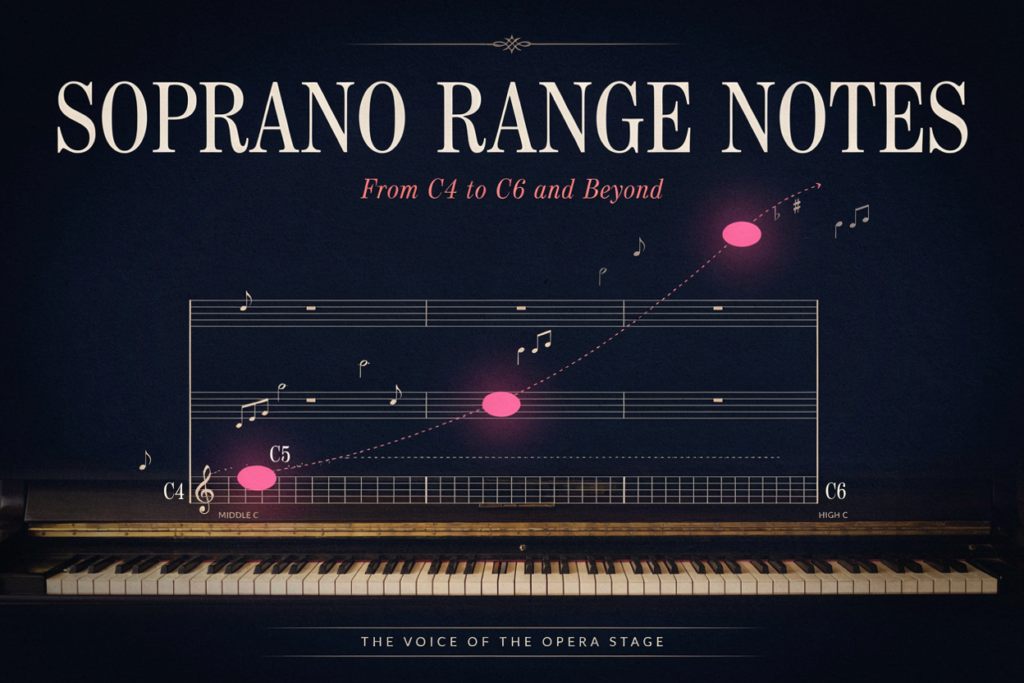
The typical soprano range spans from C4 (middle C) to C6 (two octaves above middle C). In Hertz (Hz), this translates to roughly 262 Hz at the low end to 1047 Hz at the high end. Some trained sopranos can reach A6 (880 Hz) or even higher; others have a more limited range. The range C4–C6 is the classical standard, but individual variation is completely normal.
Find out whether you’re a soprano, alto, tenor, baritone, or bass with our Voice Type Test.
The Note Names and Their Frequencies
A soprano’s range encompasses two full octaves of the chromatic scale. Middle C (C4, 262 Hz) sits at the bottom of the soprano range—if a soprano is comfortable singing middle C, she’s likely a soprano. Each octave up doubles in frequency. C5 (523 Hz) is one octave above middle C; C6 (1047 Hz) is another octave higher. Between C4 and C6, there are eleven other notes: C# (or Db), D, D# (Eb), E, F, F# (Gb), G, G# (Ab), A, A# (Bb), and B. Each note has its own frequency.
What “Range” Actually Means
Your range is the span from your lowest sustainable note to your highest sustainable note. “Sustainable” is key—you might squeeze out a very high note for a second, but if you can’t sing it on a vowel or hold it, it doesn’t count toward your range. Your range represents notes you can access with reasonable comfort and control, not just extremes you touch occasionally.
The Comfortable Soprano Zone (Tessitura)
While the soprano range spans C4–C6, most sopranos feel most comfortable singing somewhere in the middle to upper-middle of that range. For many sopranos, the “sweet spot” is roughly E4 to G5—a range of about thirteen semitones (notes). This zone, called your tessitura, is where your voice feels most resonant, most powerful, and most sustainable over a long performance.
Knowing your tessitura matters more than knowing your absolute range limits. A soprano might technically sing C4, but if she feels strained there, C4 isn’t useful for actual singing. Similarly, she might hit C6 on a good day, but if it’s shaky and exhausting, that’s not practical either. Your tessitura is where you’d want to live during a song—that’s your real, working range.
Understanding tessitura helps you understand why two sopranos with the same C4–C6 range might sound different. One might be most comfortable E4–G5; another might shine D4–F5. The comfortable zone defines how the voice is actually used.
Soprano Subtypes and Their Ranges
Not all sopranos are created equal. Classical voice training divides sopranos into three subtypes based on tessitura and tonal quality. These subtypes don’t change your fundamental voice type—you’re still a soprano—but they help clarify where you naturally sit and what repertoire suits you.
Coloratura Soprano
Coloratura sopranos are the highest, most agile female voices. Comfortable range: roughly D4–G5, with the ability to reach up to A6 or beyond in training. Coloratura means “colored” or “elaborate” in Italian—coloraturas are known for their ability to sing fast, intricate passages with many notes. Think the Queen of the Night in Mozart’s “Magic Flute”—that’s a iconic coloratura soprano role requiring incredible agility, control, and high range. Coloraturas often have a bright, piercing tone and can project powerfully despite being lighter voices.
Lyric Soprano
Lyric sopranos are the middle sopranos, warm and flexible. Comfortable range: roughly C4–G5. Lyric sopranos are the most common soprano subtype and have a warm, almost “golden” tone quality. They excel in lyric repertoire (hence the name)—songs that emphasize beauty of tone and phrasing over extreme range or virtuosity. Many musical theatre sopranos are lyric sopranos; many pop and classical singers fall into this category. Lyric sopranos can be trained to reach higher or lower, but their natural home is in the middle of the soprano range.
Dramatic Soprano
Dramatic sopranos are the lowest and most powerful sopranos. Comfortable range: roughly B3–G5 (or even lower). Dramatic sopranos have a rich, powerful, sometimes almost “dusky” tone—fuller than coloratura, darker than lyric. They excel in dramatic, emotionally intense music where power and presence matter. Many Wagnerian opera sopranos are dramatic sopranos; many powerful gospel sopranos fall here too. A dramatic soprano might technically reach C6, but her natural strength sits lower, and she excels when singing in roles that don’t require the extreme altitude.
Real Sopranos and Their Actual Ranges
Individual variation is important. Not every soprano fits neatly into one subtype. A lyric soprano might have the agility of a coloratura soprano or the power of a dramatic soprano. These categories are guidelines, not absolute rules.
When exploring famous soprano singers, you’ll notice that voice type names don’t always appear. A soprano known for powerful belting in contemporary music might never be labeled “dramatic soprano” formally, but the description fits. A soprano famous for soaring, pristine classical performances might be lyric or coloratura depending on the repertoire she chooses.
The key insight: your soprano range and subtype are descriptive, not prescriptive. They help you understand your voice and find music that suits it. They don’t limit what you can do—training can extend range and develop different qualities. But they do reflect your natural inclinations and starting point.
Soprano Range Reference Chart
| Note | Octave | Frequency (Hz) | Typical Use |
|---|---|---|---|
| C | 4 | 262 | Bottom of soprano range; less common for lyric sopranos |
| E | 4 | 330 | Bottom of comfortable zone for many sopranos |
| G | 4 | 392 | Lower-middle comfortable zone |
| C | 5 | 523 | Middle of soprano range; very comfortable for most sopranos |
| E | 5 | 659 | Upper-middle comfortable zone |
| G | 5 | 784 | Upper comfortable zone for most sopranos |
| C | 6 | 1047 | Top of typical soprano range; requires technique |
| A | 6 | 880 | Extended high range; trained sopranos only |
Can I Sing Higher or Lower Than My Natural Range?
Yes, with training. A soprano whose comfortable range is D4–G5 might, over months or years of work with a vocal coach, extend down to B3 or up to B5 or higher. The ceiling and floor can move. What rarely changes is your tessitura, your preferred zone—the place where your voice naturally thrives.
This is important: extending range takes intentional, consistent work. It’s not something that happens accidentally. If you want to access notes below your natural range, you’ll develop them through exercises like sirens, slides, and scales specifically designed to expand downward. The same applies upward.
Understanding your voice type deeply and working with a vocal coach helps you know which extensions are realistic for you. A lyric soprano might realistically extend into dramatic territory or develop some coloratura agility—but forcing yourself into a subtype that doesn’t match your vocal anatomy can lead to strain.
FAQ
What’s the difference between soprano, mezzo-soprano, and alto ranges? Soprano typically ranges C4–C6 with a comfortable zone E4–G5. Mezzo-soprano ranges A3–A5 with a comfortable zone around C4–C5. Alto ranges G3–E5 with a comfortable zone G3–E4. Sopranos are the highest; mezzos are middle-high; altos are lower. Individual ranges overlap, but the classifications reflect both range and characteristic tone quality.
Can I sing higher than C6 if I’m a soprano? Yes. Some trained sopranos can reach A6, B6, or even higher. But this requires intentional training and isn’t the case for every soprano. If high notes come naturally, great; if not, there’s no shame in focusing on where your voice excels. Exploring famous sopranos shows that successful singers focus on their strengths rather than forcing into an ideal they don’t naturally fit.
How do I know if I’m a coloratura, lyric, or dramatic soprano? Listen to where your voice feels most comfortable and powerful. If high, agile passages feel natural, you might lean coloratura. If warm, lyrical singing feels most at home, you’re likely lyric. If your voice feels rich and powerful even at lower soprano notes, you might be dramatic. These categories aren’t strict; many singers blend characteristics. A vocal coach can help you identify your subtype more precisely.
If I can barely hit C6, am I still a soprano? Absolutely. Your voice type is defined by your natural, comfortable range and tone quality—not by whether you can hit the absolute ceiling of the soprano range. Plenty of lyric sopranos don’t regularly sing C6. If you’re comfortable in the C4–G5 zone and feel like a soprano, you are one. Range is broader than just the extremes.
Does my soprano range change as I age or with training? Yes, both. Voice training can extend your range over months and years. Age also affects range; soprano voices sometimes deepen slightly with age (moving toward mezzo-soprano territory), though this varies widely. Your voice type may evolve subtly, but the core classification usually stays stable. Regular vocal practice and healthy technique help maintain and develop range throughout life.

Benjamin Parker is a voice classification and singing analysis writer at VoiceTypeTest. He focuses on vocal type identification, vocal range analysis, pitch recognition, and singing education tools for vocalists, musicians, choir singers, and beginners.