
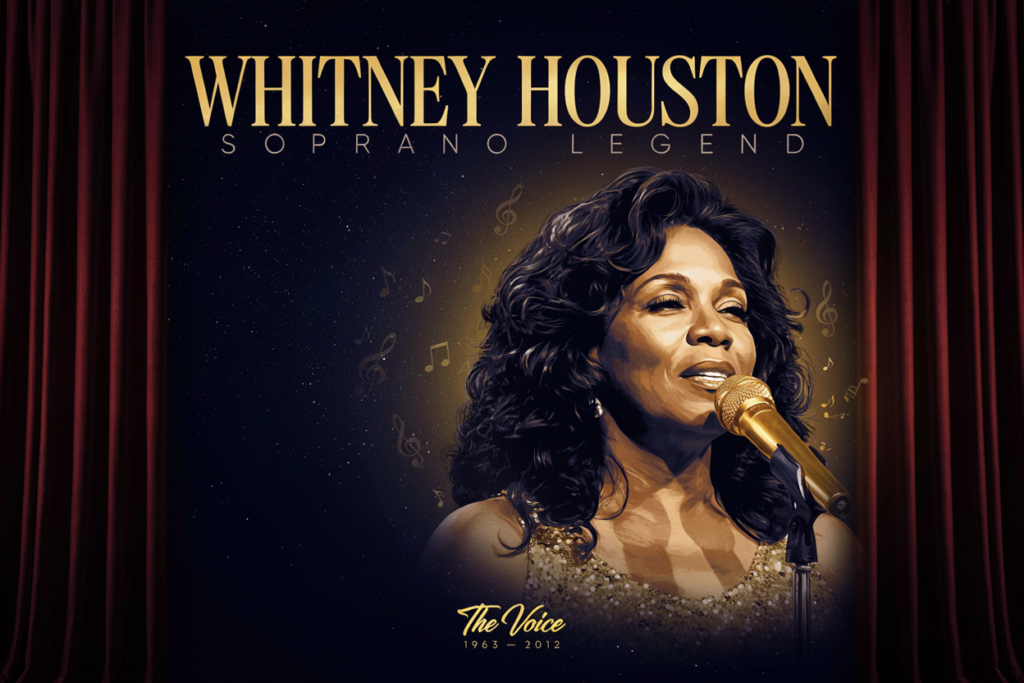
Whitney Houston is most often described as a soprano or soprano-leaning pop/R&B voice, though some listeners describe her as mezzo-soprano because of her rich middle register, powerful chest mix, and darker tone in parts of her career. The safest answer is that Whitney’s voice had many soprano-like qualities, especially in her upper range, but her pop, gospel, and R&B style makes her harder to classify than a classical opera singer.
Her voice type should not be judged by range alone. A singer’s classification depends on tessitura, tone, vocal weight, passaggio, resonance, and where the voice sounds most natural. If you want to compare your own range with standard categories, start with the vocal range calculator and then use a voice type range chart to understand what the numbers may suggest.
Quick Answer: What Voice Type Was Whitney Houston?
Whitney Houston was most likely a soprano-leaning pop/R&B singer with a strong gospel foundation, a powerful belt, a rich middle voice, and excellent upper-register access. She is often grouped with sopranos because of her high notes, clarity, resonance, and agility, but her warm tone and strong lower-middle register make the mezzo-soprano debate understandable.
| Vocal Factor | What It Suggests |
|---|---|
| Strong upper range | Soprano-leaning ability |
| Rich middle voice | Mezzo-like color to some listeners |
| Powerful belt | Pop/R&B technique, not a voice type by itself |
| Gospel-influenced phrasing | Flexible register control |
| Darker later-career tone | Vocal change over time, not automatic reclassification |
The key point: Whitney Houston was not powerful because she fit one label perfectly. She was powerful because she combined range, resonance, emotional delivery, control, and musical instinct at an exceptional level.
Why Whitney Houston Is Hard to Classify
Pop and R&B singers are not always classified the same way as opera singers. Classical voice types are based heavily on fach, acoustic projection, passaggio, tessitura, and orchestral role. Pop singers use microphones, studio production, stylistic belting, riffs, runs, and genre-specific tone shaping.
That is why two listeners can hear the same Whitney Houston performance and describe it differently. One may hear soprano brightness in the high notes. Another may hear mezzo-like warmth in the middle voice. Both observations can describe part of the sound, but neither should be used alone.
For a clearer explanation of this difference, read the guide on voice type vs vocal range. It explains why the highest note a singer can hit is not enough to identify voice type.
Whitney Houston’s Vocal Range vs Voice Type
Whitney Houston had a wide usable range, but range is only one part of voice classification. Many singers can train notes outside their most natural vocal category. A soprano may have strong low notes, and a mezzo may have impressive high notes.
What matters more is where the voice sounds most stable, expressive, and efficient. This is called tessitura. A singer’s tessitura is the part of the range where they can sing comfortably and repeatedly without sounding forced. If you are new to this idea, the article on what tessitura means will help you understand why Whitney’s comfortable singing area matters more than one isolated high or low note.
In Whitney’s case, her most iconic singing often sits in a powerful middle-to-upper belt area, with the ability to open into ringing high notes. That soprano-like upper access is one reason many vocal analysts place her closer to soprano than mezzo-soprano.
Was Whitney Houston a Soprano?
Whitney Houston is commonly described as a soprano because her voice had strong upper extension, clear high notes, agile phrasing, and a bright resonance when she wanted it. Her big ballads often show a voice that can rise above the arrangement without losing clarity.
Soprano does not mean “thin” or “light.” Some sopranos have dramatic power, strong middle voices, and rich tone. Whitney’s voice could sound warm and full, but that does not automatically make her a mezzo-soprano. The guide to the soprano voice explains how soprano voices can vary widely in tone, weight, and style.
Whitney’s singing also had extraordinary dynamic control. She could begin a phrase softly, build intensity, add vibrato, shape vowels, and finish with a resonant belt. That balance of power and precision is a major reason she became known as “The Voice.”
Why Some People Call Her a Mezzo-Soprano
Some listeners describe Whitney Houston as mezzo-soprano because her tone was not always light or bright. She had a rich chest voice, a strong middle register, and a darker color in some recordings and later live performances.
That interpretation is understandable, but tone color alone does not decide voice type. A soprano can have a warm tone, and a mezzo can have high notes. The classification depends on the whole voice: tessitura, passaggio, vocal weight, and how the registers function together.
If you are comparing female categories, the guide to female voice types gives broader context, while the mezzo-soprano voice page explains what usually separates mezzo-soprano from soprano.
What Made Whitney Houston’s Voice Unique?
Whitney Houston’s voice was not just about high notes. Her artistry came from the way she controlled every part of a phrase.
Her most important vocal traits included:
| Trait | Why It Mattered |
|---|---|
| Resonance | Made her voice sound large and clear |
| Breath control | Helped her sustain long phrases |
| Vibrato | Added emotion and polish |
| Melisma | Gave gospel/R&B movement to lines |
| Dynamic control | Allowed soft-to-powerful build-ups |
| Belt coordination | Created intensity without losing pitch focus |
| Emotional phrasing | Made familiar melodies feel personal |
Her gospel background strongly shaped her sound. She used runs, call-and-response energy, expressive vowels, and dramatic phrasing in a way that felt natural rather than decorative.
Whitney Houston Compared With Other Singers
Whitney Houston is often compared with other major vocalists, but each singer has a different vocal identity.
Compared with Mariah Carey’s voice type, Whitney is usually discussed more for her balanced power, belt clarity, and emotional phrasing, while Mariah is often associated with extreme upper extension and whistle-register use.
Compared with Beyoncé’s voice type, Whitney’s sound is often described as more classic pop-gospel ballad power, while Beyoncé is frequently analyzed for rhythmic precision, stamina, agility, and modern R&B control.
Compared with Adele’s voice type, Whitney had more soprano-like upper brilliance, while Adele is usually discussed for a darker, weightier pop tone.
These comparisons are useful, but they should not turn into simple rankings. Voice type is not the same as vocal greatness.
Can You Sing Like Whitney Houston?
You can study Whitney Houston’s phrasing, breath control, emotional delivery, and vowel shaping, but copying her biggest belts without training can cause strain. Her sound came from years of musical experience, gospel influence, and refined vocal control.
If you want to understand your own voice, use a singing voice test instead of trying to force your range into Whitney’s songs. A voice analyzer can help you observe pitch and voice behavior, while a pitch detector or vocal pitch monitor can help you track notes during practice.
The better goal is not to sound exactly like Whitney. The better goal is to learn from her control, musicality, and emotional honesty while building your own healthy voice.
Common Mistakes When Analyzing Whitney Houston’s Voice
Avoid these mistakes when discussing Whitney Houston’s voice type:
- Judging her voice from one high note or one low note
- Assuming a dark tone always means mezzo-soprano
- Treating belt range as the same thing as voice type
- Ignoring tessitura and passaggio
- Using opera fach too rigidly for a pop/R&B singer
- Forgetting that voices can change over a career
- Copying difficult belts without proper technique
- Comparing singers as if voice type is a competition
A better analysis looks at the whole instrument, not just the most dramatic moments.
FAQ
What voice type was Whitney Houston?
Whitney Houston is most often described as a soprano or soprano-leaning pop/R&B voice, though some listeners hear mezzo-soprano qualities in her rich middle register.
Was Whitney Houston a soprano or mezzo-soprano?
She is usually considered closer to soprano, but the mezzo-soprano debate exists because of her warm tone, strong chest mix, and darker vocal color in some performances.
What was Whitney Houston’s vocal range?
Her exact range varies depending on source and performance, but she was known for a wide range, powerful belts, and strong upper-register access. Range alone does not determine voice type.
Why do some people call Whitney Houston a mezzo-soprano?
Some listeners focus on her rich lower and middle voice. However, tone color alone is not enough to classify a singer as mezzo-soprano.
Was Whitney Houston a dramatic soprano?
In pop discussions, some people use terms like dramatic or spinto to describe her power, but those are classical fach terms and should be used carefully outside opera.
What made Whitney Houston’s voice so powerful?
Her power came from resonance, breath control, gospel phrasing, dynamic control, strong belt coordination, and emotional delivery.
Did Whitney Houston’s voice change over time?
Yes. Like many singers, her tone and vocal condition changed over different career periods. That does not mean every later change equals a new voice type.
Is vocal range the same as voice type?
No. Vocal range is the span from low to high notes. Voice type also depends on tessitura, tone, passaggio, vocal weight, and comfort.
Can I test if my voice is like Whitney Houston’s?
You can test your own range and pitch behavior, but your goal should be to understand your voice rather than copy Whitney’s exact sound.
What should singers learn from Whitney Houston?
Singers can learn phrasing, breath control, emotional delivery, vowel shaping, dynamic contrast, and musical storytelling from Whitney Houston.

Benjamin Parker is a voice classification and singing analysis writer at VoiceTypeTest. He focuses on vocal type identification, vocal range analysis, pitch recognition, and singing education tools for vocalists, musicians, choir singers, and beginners.