
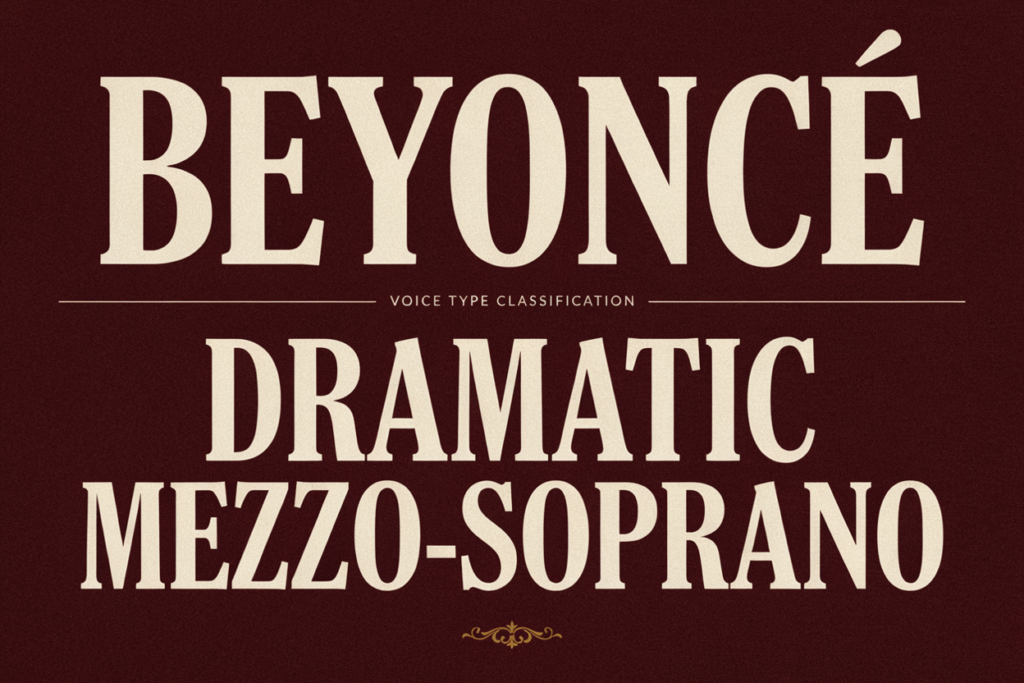
Beyoncé is most often described as a mezzo-soprano, specifically a powerful pop/R&B mezzo-soprano with dramatic qualities. Her voice has strong middle-register weight, rich resonance, excellent belt control, agile runs, and remarkable live stamina. Some listeners hear soprano-like brightness in parts of her upper range, but mezzo-soprano is usually the safer practical label.
Her voice type should not be judged by high notes alone. A singer’s classification depends on range, tessitura, tone, passaggio, vocal weight, resonance, and where the voice feels most natural. If you want to compare your own voice with standard categories, start with the vocal range calculator and then compare your results with a voice type range chart.
What Voice Type Is Beyoncé?
Beyoncé is best understood as a mezzo-soprano or powerful pop/R&B mezzo voice. Her voice has a strong middle range, excellent control, and enough upper extension to sing bright high notes, but her vocal weight and grounded tone make mezzo-soprano the most useful classification.
| Vocal Factor | What It Suggests |
|---|---|
| Strong middle register | Mezzo-soprano leaning |
| Powerful belt | Pop/R&B technique and vocal weight |
| Agile riffs and runs | Advanced coordination |
| Bright upper notes | Soprano-like extension in some songs |
| Live stamina | Breath control and performance conditioning |
The key point is that Beyoncé’s voice is not only powerful. It is also precise, rhythmic, flexible, and highly controlled.
Why Beyoncé Is Usually Called a Mezzo-Soprano
Beyoncé is usually classified as a mezzo-soprano because her voice has a strong middle center and noticeable vocal weight. Mezzo-soprano voices often sit between soprano and contralto, with warmth and strength in the middle register. Beyoncé’s tone has that grounded quality, especially when she sings powerful phrases, lower-middle lines, and chest-dominant mixed belts.
A mezzo-soprano does not have to be limited to low notes. Many mezzo voices can sing high, belt strongly, and move quickly through riffs and runs. Beyoncé is a good example of why mezzo-soprano should not be understood as a weaker or lower-only category.
For broader context, the guide to female voice types explains how soprano, mezzo-soprano, and contralto differ, while the mezzo-soprano voice page gives more detail on the middle female voice category.
Vocal Range vs Voice Type
Beyoncé has a wide usable range, but vocal range is not the same thing as voice type. Range means the full span from the lowest usable note to the highest note a singer can produce. Voice type is about where the voice sounds most comfortable, stable, and repeatable.
This is where tessitura matters. Tessitura means the part of the voice where a singer can sing comfortably and musically for longer periods. A singer may hit impressive high notes, but those notes do not always represent the natural center of the voice.
The guide on voice type vs vocal range explains this difference clearly, and the article on what tessitura means is useful if you want to understand why comfort matters more than one dramatic note.
Beyoncé’s tessitura and vocal weight support the mezzo-soprano label, even though she can access bright, high, soprano-like moments.
Why Some People Hear Soprano-Like Qualities
Some listeners describe Beyoncé as soprano-like because she can sing high, bright, and agile phrases. Songs with lifted choruses or intense belts can make her upper range feel very prominent. She also has the control to move through runs quickly and shape high notes with clarity.
However, high notes alone do not make a singer a soprano. A mezzo-soprano can have strong upper extension, especially with training, mix coordination, and pop/R&B technique. Beyoncé’s high notes are part of her skill set, but her overall vocal center still feels more mezzo than soprano.
If you want to understand the higher female category, the soprano voice page explains why brightness and upper range are only part of the classification.
Is Beyoncé a Dramatic Mezzo-Soprano?
Beyoncé is sometimes described as a dramatic mezzo-soprano because of her power, weight, intensity, and stage presence. That label can be useful informally, but it should be used carefully. “Dramatic mezzo-soprano” is a classical voice category, and Beyoncé is a pop, R&B, gospel-influenced, and performance-based singer rather than an opera fach case.
A safer description is: Beyoncé is a mezzo-soprano with dramatic pop/R&B qualities. This captures her vocal power without forcing her into a strict classical label.
Her dramatic quality comes from more than volume. It comes from resonance, rhythmic attack, breath control, emotional authority, and the ability to sing while performing physically demanding choreography.
What Makes Beyoncé’s Voice Unique?
Beyoncé’s voice is unique because it combines power with precision. She can sing big, but she can also sing rhythmically, softly, sharply, and with detailed control.
| Vocal Trait | Why It Matters |
|---|---|
| Belt control | Creates power without losing pitch focus |
| Riffs and runs | Shows agility and R&B fluency |
| Rhythmic precision | Keeps complex phrases locked into the groove |
| Breath control | Supports long phrases and live performance |
| Vibrato | Adds polish and emotional weight |
| Dynamic control | Lets her move from soft to explosive moments |
| Resonance | Gives her voice depth and authority |
| Stamina | Allows strong vocals during intense performances |
Her voice is not just technically strong. It is performance-ready. She can combine singing, movement, timing, and emotional delivery without letting the vocal line fall apart.
Beyoncé Compared With Other Singers
Beyoncé is often compared with other major vocalists, but each singer has a different vocal identity.
Compared with Whitney Houston’s voice type, Beyoncé shares power and gospel-influenced control, but Whitney is often discussed for classic pop-gospel resonance and soaring ballad delivery, while Beyoncé is especially known for rhythmic precision, stamina, and modern R&B control.
Compared with Mariah Carey’s voice type, Beyoncé is less centered on whistle-register extension and more focused on belt, rhythm, movement, and performance authority.
Compared with Ariana Grande’s voice type, Beyoncé has a heavier and more grounded vocal presence, while Ariana is usually described as lighter, more whistle-oriented, and more soprano-leaning.
Compared with Adele’s voice type, Beyoncé is more agile and rhythmically complex, while Adele is more associated with raw belt weight and direct emotional power.
Can You Train a Voice Like Beyoncé?
You can study Beyoncé’s breath control, rhythm, pitch accuracy, dynamic control, riffs, runs, and stage discipline. But you should not force her belts or try to copy intense riffs without building technique gradually. Powerful singing requires coordination, not throat pressure.
If you want to understand your own voice first, use a singing voice test to explore your comfortable range. A voice analyzer can help you observe pitch behavior, while a pitch detector or vocal pitch monitor can help you track notes during practice.
The better goal is not to sound exactly like Beyoncé. The better goal is to build healthy power, musical timing, and control inside your own voice.
Common Mistakes When Analyzing Beyoncé’s Voice
Avoid these mistakes:
- Assuming high notes automatically mean soprano
- Assuming vocal power equals strict classical dramatic fach
- Judging her voice from one song or live clip
- Confusing vocal range with tessitura
- Ignoring rhythm, stamina, and performance context
- Treating riffs and runs as decoration instead of technique
- Copying belts without proper coordination
- Comparing singers as if voice type is a ranking system
A better analysis looks at the whole voice: tone, comfort, weight, range, agility, rhythm, and how the singer uses the voice in real performance.
FAQ
What voice type is Beyoncé?
Beyoncé is most often described as a mezzo-soprano, especially a powerful pop/R&B mezzo-soprano with dramatic qualities.
Is Beyoncé a mezzo-soprano?
Yes, mezzo-soprano is the safest practical label because her voice has strong middle-register weight, rich tone, powerful belt control, and grounded resonance.
Is Beyoncé a soprano?
Some listeners hear soprano-like qualities in her upper range, but her overall vocal weight and comfortable middle range make mezzo-soprano the more useful classification.
What is Beyoncé’s vocal range?
Her exact range varies by source and performance. For classification, tessitura, tone, vocal weight, and comfort matter more than one highest or lowest note.
Is Beyoncé a dramatic mezzo-soprano?
She has dramatic pop/R&B qualities, including power, intensity, resonance, and stamina. However, dramatic mezzo-soprano is a classical fach term, so it should be used carefully.
Why is Beyoncé’s voice so powerful?
Her power comes from breath control, resonance, strong mix coordination, rhythmic precision, belt technique, and years of performance conditioning.
Can Beyoncé sing soprano notes?
Yes, she can sing high notes and bright upper phrases, but singing soprano-range notes does not automatically make a singer a soprano.
Is vocal range the same as voice type?
No. Range is the span of notes a singer can produce. Voice type also depends on tessitura, tone, passaggio, vocal weight, and comfort.
Can I sing like Beyoncé?
You can study her rhythm, breath control, dynamics, and riffs, but do not force her belts. Build strength and coordination gradually.
How can I find my own voice type?
Test your vocal range, notice your comfortable tessitura, compare your results with standard voice categories, and avoid judging your type from one extreme note.
Sing a few notes and discover your estimated voice type with our Voice Type Test.
Final Note
Beyoncé is best described as a mezzo-soprano or powerful pop/R&B mezzo voice with dramatic qualities. Her high notes and bright belts are impressive, but her strongest vocal identity comes from middle-register strength, rhythmic control, resonance, agility, and live stamina.
The most useful lesson from Beyoncé’s voice is that power is not just loudness. True vocal power comes from control, timing, support, and the ability to deliver emotion without losing precision.

Benjamin Parker is a voice classification and singing analysis writer at VoiceTypeTest. He focuses on vocal type identification, vocal range analysis, pitch recognition, and singing education tools for vocalists, musicians, choir singers, and beginners.