
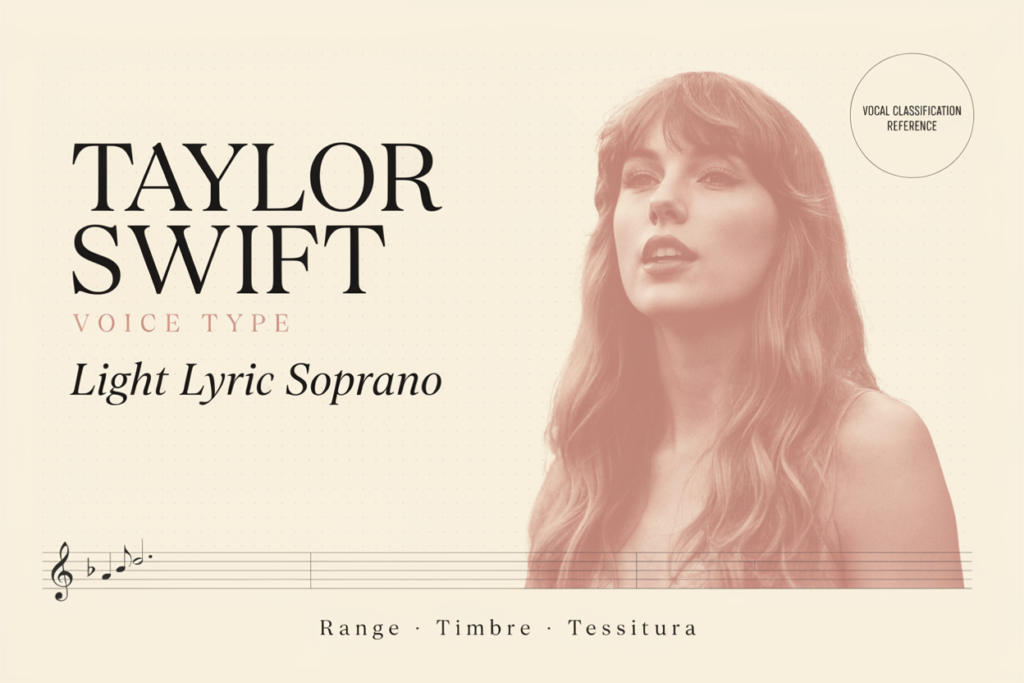
Taylor Swift is most often described as a mezzo-soprano, or more specifically a light lyric mezzo-soprano in pop vocal analysis. Her voice usually sits comfortably in a conversational lower-to-middle range, with clear diction, warm tone, and strong storytelling delivery. Some listeners hear soprano-like brightness in parts of her upper range, but mezzo-soprano is usually the safer practical label.
Her voice type should not be judged by one high note, one low note, or one era. Voice classification depends on range, tessitura, tone, passaggio, vocal weight, and where the voice feels most natural. If you want to compare your own voice with standard categories, start with the vocal range calculator and then compare your results with a voice type range chart.
What Voice Type Is Taylor Swift?
Taylor Swift is best understood as a mezzo-soprano or light lyric mezzo-soprano-style pop singer. Her voice is not mainly built around extreme high notes or heavy belting. Instead, her strongest area is a clear, expressive middle range that supports storytelling, lyric clarity, and emotional phrasing.
| Vocal Factor | What It Suggests |
|---|---|
| Conversational midrange | Mezzo-soprano leaning |
| Lower pop phrasing | Alto-like range use, not automatic contralto |
| Bright upper moments | Some soprano-like color |
| Clear diction | Storytelling-focused vocal style |
| Era-to-era changes | Production and genre affect perception |
The main point is that Taylor’s strength is not vocal acrobatics. Her voice works because it serves the song, the lyric, and the emotional arc.
Why Taylor Swift Is Usually Called a Mezzo-Soprano
Taylor Swift is usually called a mezzo-soprano because her voice often feels most natural in the lower-to-middle part of the female pop range. She frequently uses speech-like phrasing, relaxed melodic lines, and a warm middle register. This is especially clear in songs where the vocal sits close to spoken storytelling rather than high, dramatic display.
Mezzo-soprano voices often have more middle-register warmth than sopranos, but they do not have to sound dark or heavy all the time. Taylor’s tone is lighter than many dramatic mezzo voices, which is why “light lyric mezzo-soprano” can be a useful description.
For broader context, the guide to female voice types explains how soprano, mezzo-soprano, and contralto categories differ, while the mezzo-soprano voice page gives more detail on the middle female voice category.
Vocal Range vs Voice Type
Taylor Swift has sung across different ranges depending on the song, key, and era, but range alone does not decide voice type. Vocal range means the full span from the lowest usable note to the highest usable note. Voice type is more about the area where the voice sounds comfortable, stable, and repeatable.
That comfortable area is called tessitura. A singer may be able to reach a high note for one chorus or touch a low note for effect, but those notes do not always show the natural center of the voice. The guide on voice type vs vocal range explains this difference clearly, and the article on what tessitura means is useful if you want to understand why comfort matters more than extremes.
Taylor’s tessitura often supports a mezzo-soprano reading because so much of her music works in a clear, lyric-friendly middle space.
Is Taylor Swift an Alto or Contralto?
Taylor Swift is sometimes described as alto-like because she often sings in a lower pop range. However, alto is usually a choir part, not the same thing as a solo voice type. A singer can sing alto parts or low harmonies without being a true contralto.
Contralto is a rare female voice type with a naturally low tessitura, darker weight, and comfortable low extension. Taylor’s voice does not need that label to make sense. She can use lower phrasing, but her overall vocal identity is better explained as mezzo-soprano or light lyric mezzo-soprano.
If you are unsure about this distinction, the guide on alto vs contralto explains why choir roles and solo voice types should not be mixed too quickly.
Why Some People Hear Soprano-Like Qualities
Some listeners hear soprano-like qualities in Taylor Swift’s voice because she can use brighter upper tones in certain songs. Pop singers often move through different colors depending on melody, production, and emotional setting. A chorus may sit higher than the verse, and a studio arrangement may make the upper voice sound more polished or lifted.
Still, soprano is not the safest overall label because Taylor’s most recognizable vocal identity is not centered on upper-range display. Her voice usually feels most natural when it stays connected to speech, lyric rhythm, and middle-range melody. The soprano voice page is helpful for understanding why brightness alone does not always mean soprano classification.
What Makes Taylor Swift’s Voice Unique?
Taylor Swift’s voice is unique because it is built around storytelling. She does not usually sing to show off the largest range or fastest runs. She sings to make the listener understand the lyric.
| Vocal Trait | Why It Matters |
|---|---|
| Clear diction | Helps every lyric land |
| Conversational tone | Makes songs feel personal |
| Middle-range comfort | Supports long narrative phrases |
| Emotional timing | Makes small lines feel important |
| Rhythmic phrasing | Keeps verses moving naturally |
| Light vocal color | Fits pop, country, and folk production |
| Controlled restraint | Serves the song instead of overpowering it |
Her vocal strength is easy to underestimate because it is not always flashy. But making a lyric sound natural, memorable, and emotionally direct is a real skill.
How Taylor Swift’s Voice Changed Across Eras
Taylor Swift’s voice has changed with her music. In her country era, her tone often sounded brighter, youthful, and influenced by country phrasing. In her pop era, the vocal production became cleaner, more rhythmic, and more polished. In her folk and indie-influenced songs, she often used softer delivery, lower keys, and more intimate textures. In her modern work, her voice often sounds darker, steadier, and more conversational.
These changes do not mean her voice type completely changed. They show how arrangement, genre, maturity, and production can shift how a singer is perceived.
Taylor Swift Compared With Other Singers
Taylor Swift is often compared with other pop singers, but her vocal goal is different.
Compared with Billie Eilish’s voice type, Taylor is usually more narrative and speech-like, while Billie leans more into breathy intimacy and close-mic softness.
Compared with Lana Del Rey’s voice type, Taylor’s voice is less smoky and cinematic, but both singers use lower pop phrasing and atmosphere in different ways.
Compared with Ariana Grande’s voice type, Taylor is less focused on upper agility and whistle-register effects. Ariana’s voice is more soprano-like, while Taylor’s sits closer to a storytelling mezzo-pop style.
Compared with Adele’s voice type, Taylor has a lighter, more conversational tone, while Adele is more belt-forward and vocally weighty.
Can You Sing Like Taylor Swift?
Taylor Swift songs can feel simple at first, but they require good phrasing, timing, diction, and emotional clarity. The challenge is not always extreme range. It is making the lyric feel natural without going flat, rushing, or losing tone.
If you want to sing Taylor Swift songs, choose keys that fit your own tessitura instead of forcing your voice too low or too high. Use a singing voice test to explore your comfort zone, a voice analyzer to observe pitch behavior, and a pitch detector or vocal pitch monitor to track notes during practice.
The better goal is not to copy Taylor exactly. The better goal is to learn how she uses lyric timing, phrasing, and emotional detail to make songs feel personal.
Common Mistakes When Analyzing Taylor Swift’s Voice
Avoid these mistakes:
- Assuming lower songs automatically mean contralto
- Confusing alto choir parts with solo voice type
- Judging her voice from one era or one song
- Ignoring tessitura and vocal comfort
- Comparing her unfairly with vocal acrobats
- Treating voice type as a ranking system
- Assuming a less flashy voice means weak technique
- Ignoring how songwriting affects vocal style
A better analysis looks at the whole voice: tone, range, comfort, phrasing, diction, production, and musical purpose.
FAQ
What voice type is Taylor Swift?
Taylor Swift is most often described as a mezzo-soprano or light lyric mezzo-soprano-style pop singer.
Is Taylor Swift a mezzo-soprano?
Yes, mezzo-soprano is the safest practical label because her voice often sits comfortably in a lower-to-middle range with warm conversational tone.
Is Taylor Swift a soprano?
Some listeners hear soprano-like brightness in parts of her upper range, but her overall vocal identity is usually closer to mezzo-soprano.
Is Taylor Swift an alto?
Not exactly. She may sing in an alto-like range sometimes, but alto is often a choir part. Mezzo-soprano is a more accurate solo voice-type label.
What is Taylor Swift’s vocal range?
Her exact range varies by song and source. For classification, her tessitura and vocal comfort matter more than one highest or lowest note.
Why does Taylor Swift sing in a lower range?
Lower and middle ranges help her lyrics sound conversational, personal, and emotionally direct.
Did Taylor Swift’s voice change over time?
Yes. Her tone, production, and delivery changed across country, pop, folk, and modern eras, but that does not mean her basic voice type completely changed.
Is Taylor Swift hard to sing?
Her songs may not always require extreme range, but they can be challenging because they need clear diction, timing, breath control, and emotional phrasing.
Can I sing like Taylor Swift?
You can study her storytelling, rhythm, and lyric delivery, but choose keys that fit your own range instead of forcing her exact notes.
How can I find my own voice type?
Test your range, notice your tessitura, compare your comfort zone with standard categories, and avoid judging your type from one song or one extreme note.

Benjamin Parker is a voice classification and singing analysis writer at VoiceTypeTest. He focuses on vocal type identification, vocal range analysis, pitch recognition, and singing education tools for vocalists, musicians, choir singers, and beginners.