
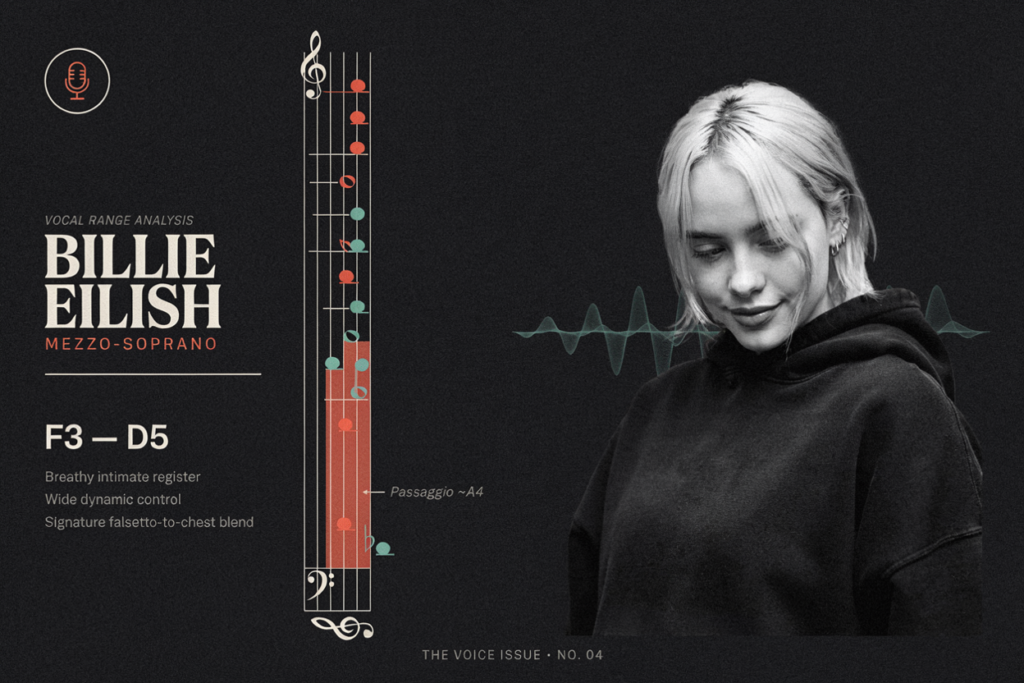
Billie Eilish is often described as a mezzo-soprano or light soprano/soubrette-like pop voice, depending on the analysis. The safest way to describe her is a soft, breathy alt-pop vocalist with a low-to-middle tessitura and light upper access. Her voice sounds intimate, airy, and sometimes low, but that does not automatically make her alto or contralto.
Billie’s voice type should not be judged from whispery tone alone. A singer’s classification depends on range, tessitura, tone, passaggio, vocal weight, and where the voice feels most natural. If you want to compare your own voice with standard categories, start with the vocal range calculator and then compare your results with a voice type range chart.
What Voice Type Is Billie Eilish?
Billie Eilish is commonly described as either a mezzo-soprano or a light soprano/soubrette-like pop voice. Her low, breathy delivery makes some listeners hear mezzo qualities, while her lighter tone and upper access make others describe her as soprano-like.
| Vocal Factor | What It Suggests |
|---|---|
| Breathy, intimate tone | Pop style and microphone technique |
| Low-to-middle phrasing | Mezzo-like color to some listeners |
| Light upper access | Soprano or soubrette-like quality |
| Soft dynamics | Controlled style, not weak singing |
| Whispery delivery | Vocal color, not voice type by itself |
The best answer is not one extreme label. Billie’s voice is better understood by looking at how she uses softness, pitch control, close-mic detail, and emotional restraint.
Why Billie Eilish Is Hard to Classify
Billie Eilish is hard to classify because her style is built around quiet intensity. Many singers reveal their voice type through big belts, long sustained notes, or traditional range display. Billie often does the opposite. She sings close to the microphone, uses breathy textures, keeps dynamics soft, and lets small vocal details carry the emotion.
This can make her voice sound lower or darker than it may be in a traditional singing setting. A quiet vocal does not mean a weak vocal, and a breathy tone does not automatically mean alto, contralto, or mezzo-soprano.
That is why the guide on voice type vs vocal range is useful. Voice type is not the same as mood, volume, genre, or production style.
Billie Eilish’s Vocal Range vs Voice Type
Vocal range means the full span from the lowest note a singer can produce to the highest note they can sing. Voice type is different. It looks at where the voice sounds most comfortable, balanced, and repeatable.
The most useful concept here is tessitura. Tessitura means the part of the voice where a singer can perform comfortably for longer phrases. A singer may touch lower notes for color or higher notes for effect, but those extremes do not always reveal the natural center of the voice. The article on what tessitura means explains why comfort matters more than one isolated note.
Billie’s music often sits in a lower, softer vocal space, but she also uses lighter upper tones. That is why her classification is debated between mezzo-soprano and lighter soprano-like categories.
Is Billie Eilish a Mezzo-Soprano?
Billie Eilish is often called a mezzo-soprano because her voice frequently sits in a low-to-middle area and has a warm, airy color. Mezzo-soprano voices commonly have more middle-register warmth than sopranos, and Billie’s songs often highlight that kind of intimate middle range.
The mezzo label makes sense as a practical pop description, especially when focusing on her relaxed lower phrasing and darker vocal colors. To understand the category more clearly, read the guide to the mezzo-soprano voice and the broader overview of female voice types.
Still, mezzo-soprano should not be claimed only because Billie sings softly or uses breathy tone. Those are stylistic choices, not complete voice-type evidence.
Why Some People Hear a Soprano-Like Quality
Some listeners describe Billie Eilish as soprano-like because her voice can sound light, youthful, and flexible in higher passages. A soprano does not always have to sing loudly or dramatically. In pop, a soprano may use soft head voice, light tone, and close-mic phrasing instead of operatic projection.
Billie’s voice often avoids heavy belting, which can make it harder to hear her full vocal weight. Her lighter upper access and soft head-voice colors can support a soprano or soubrette-like interpretation. The soprano voice page gives more context on how varied soprano voices can be.
A careful conclusion is that Billie is best understood as a breathy, low-to-middle pop voice with both mezzo-like warmth and light soprano-like qualities.
What Makes Billie Eilish’s Voice Unique?
Billie Eilish’s voice is unique because she uses restraint as a strength. Instead of trying to overpower the track, she often lets the microphone capture small details: breath, consonants, soft pitch movement, and subtle changes in tone.
| Vocal Trait | Why It Matters |
|---|---|
| Breathy tone | Creates intimacy and vulnerability |
| Close-mic delivery | Makes quiet details feel emotionally large |
| Soft dynamics | Builds tension without belting |
| Airy texture | Gives the voice a floating quality |
| Layered harmonies | Adds depth without heavy volume |
| Emotional restraint | Makes the vocal feel private and direct |
| Low-to-middle phrasing | Supports her dark alt-pop mood |
Her singing proves that control is not always loud. A quiet vocal can still require strong pitch accuracy, breath management, and musical awareness.
Billie Eilish Compared With Other Singers
Billie Eilish is often compared with other pop singers, but her vocal identity is very specific.
Compared with Lana Del Rey’s voice type, Billie also uses intimacy and dark atmosphere, but Lana’s style leans more cinematic and retro, while Billie’s sound is more minimalist, modern, and close-mic focused.
Compared with Ariana Grande’s voice type, Billie uses far less upper-register display. Ariana is known for agility, whistle notes, and bright soprano-like movement, while Billie is known for restraint, breathiness, and emotional detail.
Compared with Taylor Swift’s voice type, Billie’s delivery is usually softer and more atmospheric, while Taylor is often more speech-like and narrative-focused.
Compared with Adele’s voice type, Billie is much lighter and quieter in delivery, while Adele is more belt-forward, powerful, and vocally weighty.
Can You Sing Like Billie Eilish?
You can study Billie Eilish’s soft dynamics, phrasing, pitch accuracy, emotional restraint, and microphone control. But do not imitate her breathiness by pushing excess air through the voice. Too much air leakage can dry out the vocal folds and create fatigue.
A safer approach is to find your natural comfortable range first. Use a singing voice test to explore your vocal limits, a voice analyzer to observe pitch behavior, and a pitch detector or vocal pitch monitor to track notes during practice.
The goal is not to copy Billie’s tone exactly. The goal is to learn how she uses softness, space, and control to make a vocal feel emotionally close.
Common Mistakes When Analyzing Billie Eilish’s Voice
Avoid these mistakes:
- Assuming quiet singing means weak singing
- Assuming breathy tone automatically means alto
- Judging her voice from one song
- Confusing microphone style with voice type
- Ignoring tessitura and vocal comfort
- Treating pop labels exactly like opera fach
- Forcing vocal fry or excess breathiness
- Ranking singers by voice type instead of musical expression
A better analysis looks at the full picture: range, tone, comfort, vocal weight, style, production, and how the singer actually uses the voice.
FAQ
What voice type is Billie Eilish?
Billie Eilish is often described as a mezzo-soprano or light soprano/soubrette-like pop voice. The safest description is a breathy, low-to-middle pop voice with both mezzo-like warmth and light upper access.
Is Billie Eilish a soprano?
Some listeners describe her as soprano-like because of her lighter tone and upper access, but her low-to-middle phrasing makes the classification debated.
Is Billie Eilish a mezzo-soprano?
Mezzo-soprano is a reasonable practical label for Billie Eilish because much of her singing sits in a warm, low-to-middle range.
Is Billie Eilish an alto?
Not necessarily. Alto is often a choir part, not a precise solo voice type. Billie may sing in an alto-like area sometimes, but that does not automatically define her full voice type.
What is Billie Eilish’s vocal range?
Her exact range varies by source and performance. For classification, her tessitura and vocal style are more important than one highest or lowest note.
Why does Billie Eilish sing so quietly?
Quiet singing is part of her artistic style. It creates intimacy, tension, and emotional closeness, especially with close microphone technique.
Does Billie Eilish use vocal fry?
She uses vocal fry-like textures and airy effects at times, but vocal fry is a style or register effect, not a voice type.
Does breathy singing determine voice type?
No. Breathy tone affects how a voice sounds, but voice type depends on range, tessitura, tone, passaggio, weight, and comfort.
Can I sing like Billie Eilish?
You can study her phrasing and dynamics, but avoid forcing breathiness or vocal fry. Build a healthy version of your own soft singing style.
How can I find my own voice type?
Test your range, notice your comfortable tessitura, compare your results with standard voice categories, and avoid judging your type from one song or one extreme note.
Final Note
Billie Eilish is best understood as a soft, breathy pop vocalist with low-to-middle tessitura, often described as either mezzo-soprano or light soprano/soubrette-like depending on the analysis. Her voice type is debated because her style depends heavily on quiet dynamics, close-mic detail, and airy tone.
The most useful lesson from Billie is that powerful singing does not always mean loud singing. Her voice shows how softness, control, space, and emotional detail can become a signature sound.

Benjamin Parker is a voice classification and singing analysis writer at VoiceTypeTest. He focuses on vocal type identification, vocal range analysis, pitch recognition, and singing education tools for vocalists, musicians, choir singers, and beginners.